Blogia

MATEO MATHAUS: THE WORLD NOW

De l’Irlande au Portugal, la zone euro de nouveau ébranlée
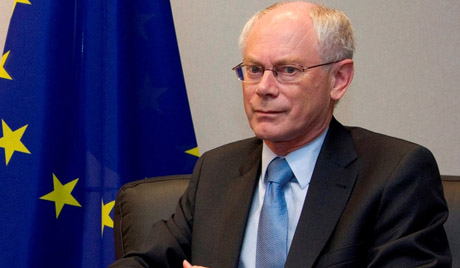
De l’Irlande au Portugal, la zone euro de nouveau ébranlée

    Herman Van Rompuy estime que l’Europe monétaire et donc toute l’Union jouent leur “survie”. Un petit vent de panique a de nouveau soufflé hier sur les marchés financiers en raison de la résurgence de craintes à propos de la zone euro. Des rumeurs circulaient sur un plan d’aide pour l’Irlande voire le Portugal alors qu’un Eurogroupe réunissant les ministres des Finances de la zone euro avait lieu en fin d’après-midi. "La Commission travaille de concert avec la Banque centrale européenne et le Fonds monétaire international et bien entendu les autorités irlandaises en vue de résoudre les graves problèmes du secteur bancaire irlandais", a déclaré le commissaire européen aux Affaires économiques Olli Rehn, en arrivant à la réunion des grands argentiers de l’Union monétaire. Le président du Conseil européen, Herman Van Rompuy, a rajouté au climat d’inquiétude en faisant une déclaration assez inhabituelle pour cet homme aux propos en général assez prudents. "Nous sommes confrontés à une crise pour notre survie", a-t-il affirmé lors d’une intervention devant un centre de réflexion bruxellois, le European Policy Center. "Nous devons tous travailler de concert afin de permettre à la zone euro de survivre. Car si la zone euro ne survit pas, l’Union européenne ne survivra pas non plus", a-t-il ajouté. La première année du traité de Lisbonne, entré en vigueur en décembre 2009, "a été marquée par la crise de la zone euro, c’était une période de survie et ce n’est pas encore terminé", a encore souligné le président du Conseil européen, dont le poste a été créé par le traité. Plutôt que l’Irlande, c’est le secteur bancaire, mis particulièrement en difficulté par l’éclatement de la bulle immobilière, qui devrait être mis sous perfusion. "Les banques irlandaises ont un vrai problème de financement", commente Bertrand Veraghaenne, chief economist à la Banque Transatlantique Belgium. Ce plan d’action rapide serait poussé par la Banque centrale européenne car elle redoute de graves répercussions sur le marché des emprunts d’Etat, selon des sources diplomatiques. Les inquiétudes sont d’ailleurs vives concernant une possible contagion de la crise irlandaise à des pays comme le Portugal, la Grèce ou l’Espagne, dont les taux d’emprunt à long terme ont également flambé la semaine dernière. Le ministre portugais des Finances, Fernando Teixeira dos Santos, a parlé d’un risque "élevé" que son pays doive aussi faire appel à l’aide de l’Europe. "Nous ne faisons pas face au problème d’un seul pays. C’est le problème de la Grèce, du Portugal et de l’Irlande", a-t-il dit. La ministre de l’Economie espagnole, Elena Salgado, a quant à elle essayé de calmer les esprits en assurant mardi qu’il n’y avait "aucune raison" que son pays soit affecté par la situation de l’Irlande et du Portugal. Ces nouvelles craintes ont eu de multiples effets sur les marchés. Elles ont d’abord affaibli l’euro qui est tombé aux alentours de 1,35 dollar. Elles ont également fait baisser les indices boursiers avec des reculs de près de 2 % un peu partout en Europe. Enfin, elles ont relancé la ruée vers le papier obligataire le plus sûr, à savoir les emprunts d’Etat allemand et accru le sentiment de défiance vis-à-vis des emprunts de l’Irlande et des pays de l’Europe du sud. Pour Bertrand Veraghaenne, la correction boursière d’hier n’a rien d’étonnant. "Les marchés étaient devenus trop complaisants par rapport à la crise de la dette souveraine". Pour lui, les dégâts ne seront pas trop graves si la crise se limite à la Grèce, au Portugal et à l’Irlande. Mais si le quatrième domino tombe, à savoir l’Espagne, "on ne pourra pas l’absorber", prévient-il. Pour lui, un éclatement de la zone euro dans les deux à trois prochaines années "n’est pas impossible". Il évalue ces risques entre 20 et 30 %.


Handelsblatt :La verdadera amenaza para el euro viene de España.


Euro-Krise: Der spanische Patient ängstigt die Märkte

Noch stehen Irland und Portugal im Mittelpunkt der Euro-Krise. Doch die wirkliche Gefahr für die Stabilität der Währungsunion geht von Spanien aus. Würden die Investoren das Vertrauen in das große EU-Land verlieren, könnte die Schuldenkrise eine völlig neue Qualität bekommen.

Anzeige
Versuchen Sie es doch mal!


Spaniens Premierminister Jose Luis Zapatero muss das Vertrauen der Anleger gewinnen. Quelle: dapdLupe

Spaniens Premierminister Jose Luis Zapatero muss das Vertrauen der Anleger gewinnen. Quelle: dapd

FRANKFURT/MADRID/LONDON. Sichtlich ermüdet präsentierte sich Spaniens Premier José Luis Rodríguez Zapatero nach Abschluss des G20-Gipfels in Seoul der Presse. Wieder einmal verhagelt ihm die Nachrichtenlage den Triumph, dass Spanien unter seiner Ägide erneut als Gast zu dem Treffen der 20 wichtigsten Industrie- und Schwellenländer eingeladen wurde. Stattdessen interessierte die Journalisten vor allem eines: Wird auch Zapateros Land in den Strudel der Schuldenkrise gezogen, die schon Griechenland, Irland und Portugal erschüttert?

Die Märkte beantworten diese Frage mit Ja. Die sich gegenläufig zum Kurs entwickelnde Rendite zehnjähriger spanischer Anleihen ist in diesem Monat rasant auf bis zu 4,6 Prozent gestiegen. Damit lag sie fast so hoch wie auf dem bisherigen Höhepunkt der Euro-Krise im Mai. Die Risikoprämie - der Renditeaufschlag von spanischen zu deutschen Staatsanleihen - lag vergangene Woche mit 2,2 Prozentpunkten schon höher als im Mai, und die Kosten von Derivaten, mit denen sich Anleger vor einem Zahlungsausfall Spaniens schützen können, erreichten ein Allzeithoch. Am Freitag entspannte sich die Lage zwar für alle Euro-Randländer etwas, trotzdem warnen Experten vor einer Zuspitzung der Lage. Denn sollte auch Spanien in den Sog der Marktturbulenzen geraten, hätte das Folgen für die Stabilität der gesamten Währungsunion.

"Würden die Investoren das Vertrauen in ein großes EU-Land wie Spanien verlieren, bekäme die Schuldenkrise eine völlig neue Qualität", fürchtet Daniel McCormack von der Investmentbank Macquarie. "Spanien macht zwölf Prozent der Wirtschaftsleistung der Euro-Zone aus, mehr als dreimal so viel wie Irland und Portugal zusammengenommen", rechnet der Volkswirt vor.

Global Markets

Weblog : Global Markets

Diskutieren Sie mit Handelsblatt-Experten das Geschehen an den weltweiten Finanzmärkten

"Die Investoren sind nervös, und die Panik kann sich schnell ausbreiten", warnt David Schnautz, Zinsstratege bei der Commerzbank. Sollte die zehnjährige Rendite spanischer Anleihen deutlich über fünf Prozent steigen, könne deshalb rasch der Verdacht aufkommen, dass die Iberer als Nächstes internationale Hilfe brauchen, um ihre Finanzprobleme in den Griff zu bekommen. Am Wochenende liefen die Spekulationen heiß, dass Irland schon bald unter den Rettungsschirm der EU und des Internationalen Währungsfonds schlüpfen muss. Die Risikoaufschläge für irische und portugiesische Staatsanleihen waren in der vergangenen Woche beinahe täglich auf neue Rekorde geschnellt.

"Spanien würde den Rettungsfonds mit seinem hohen Refinanzierungsbedarf im Zweifelsfall sehr stark strapazieren", fürchtet Schnautz. Er erwartet, dass Spanien allein im nächsten Jahr 175 Mrd. Euro an kurz laufenden Geldmarktpapieren und länger laufenden Anleihen an den Markt bringen muss. Der im Mai aufgelegte und bis Mitte 2013 geltende Rettungsfonds ist 750 Mrd. Euro schwer, kann aber nur maximal rund 600 Mrd. Euro an Krediten auszahlen. Grund dafür ist, dass der Fonds einen Puffer einbehalten muss, um von den Ratingagenturen die bestmögliche Bonitätsnote Dreifach-A zu bekommen

German Investor Confidence Gains More Than Forecast

German Investor Confidence Gains More Than Forecast

Nov and Mateo Mathaus 16, 2010 5:08 am ET

(Updates with current conditions in fifth paragraph.)

Nov. 16 (Bloomberg) -- German investor confidence rose for the first time in seven months in November as the economy, Europe’s largest, powered ahead of its euro-area neighbors.

The ZEW Center for European Economic Research in Mannheim said its index of investor and analyst expectations, which aims to predict developments six months ahead, increased to 1.8 from minus 7.2 in October. Economists expected a gain to minus 6, according to the median of 33 forecasts in a Bloomberg News survey.

Germany’s economy will expand 3.7 percent this year, according to the government’s council of economic advisers. That would be fastest growth since 1991. The performance contrasts with fellow euro-region nations such as Ireland and Greece, whose economies are contracting as their governments slash spending to rein in budget deficits.

“I doubt that the current periphery troubles will have clouded analysts’ views of the German economy,” said Jens Kramer, an economist at NordLB in Hanover. “Every single indicator shows German growth remains robust. Growth is broadening and the domestic economy is picking up.”

ZEW said its gauge of the current situation increased to 81.5 from 72.6. The euro rose after the report to $1.3612 from $1.3592 beforehand.

The benchmark DAX share index has risen 10 percent in the last six weeks, unperturbed by Ireland’s worsening fiscal crisis as German companies reported higher profits.

Profits Surge

Of the 28 companies on the DAX that have announced quarterly results since Oct. 7, more than two thirds have beaten analyst estimates for per-share income, according to data compiled by Bloomberg.

Linde AG, the world’s second biggest maker of industrial gases, said on Nov. 2 that third-quarter profit rose 50 percent.

German export-oriented companies have benefitted from stronger demand from emerging economies, particularly China.

Volkswagen AG, Europe’s largest carmaker, said on Nov. 12 that October sales rose more than twice as fast as the worldwide auto-market average, as demand for its VW and Audi models in the U.S. and China surged.

The German economy grew 0.7 percent in the third quarter after record expansion of 2.3 percent in the second, outpacing the euro region as a whole.

Debt Crisis

Still, the sovereign-debt crisis may damp German growth by curtailing demand for its goods across the region as governments introduce austerity measures.

Germany is leading a drive to remedy Ireland’s debt woes before other countries succumb to the speculation that claimed Greece as the first victim.

After 13 straight days of price declines, Irish bonds began to rally late last week as investors bet a bailout is imminent from the European Union’s 750 billion-euro ($1 trillion) fund, which was created with help from the International Monetary Fund in May to stabilize the 16-nation euro economy.

“If May’s experience is anything to go by, Germany will actually be a beneficiary of the current Ireland/Portugal crisis,” said Carsten Brzeski, an economist at ING Group in Brussels. “It will weigh on the euro and it’ll keep interest rates low.”

--With assistance from Gabi Thesing in Frankfurt and Jana Randow in Mannheim. Editors: Matthew Brockett, Jennifer Freedman

Crazy Horse :Chavez Creates Socialist Bourse, Promises High Yields.

Crazy Horse :Chavez Creates Socialist Bourse, Promises High Yields.

Crazy Horse :Chavez Creates Socialist Bourse, Promises High Yields

Nov 14, 2010 2:45 pm ET

(Adds Chavez’s comments in fourth paragraph.)

Nov. 14 (Bloomberg) -- Venezuelan President Hugo Chavez said he signed a law to create a “socialist” state-run Public Bond Market that will offer local investors high yields to stimulate saving.

The Public Bond Market, which will begin operations in December, will allow state-run companies to sell debt to finance operations and individuals to seek investment opportunities, Chavez said.

Chavez tightened his grip on the financial industry this year by closing more than a dozen banks and 40 brokerages that he said committed “fraud” and set artificial exchange rates. He said investors will have their investments guaranteed by the state. Caracas’s private stock exchange has seen trading volumes plummet since 2007 after the nationalization of companies including Cemex SAB and Cia Anonima Nacional Telefonos de Venezuela, known as CANTV.

“The banking and brokerage crisis has allowed us to draft this law,” Chavez said today on state television during his “Alo Presidente” program. “Don’t spend all your year-end bonuses, invest in the bourse and the state will guarantee your money with good yields.”

Yields Rise

The government’s average dollar-bond yield rose 20 basis points, or 0.2 percentage points, to 13.23 percent on Nov. 12, according to JPMorgan indexes.

A draft of the bill that was approved in the National Assembly said that besides state companies, joint ventures, community councils and private companies will be authorized to sell debt to finance operations.

The Securities Regulator authorized state oil company Petroleos de Venezuela SA to sell $3 billion of bonds due in 2017. The bonds were sold on Oct. 25 in the secondary market through the Public Bond Market, according to a statement dated Oct. 8 and published Nov. 10.

The law will be published tomorrow in the government’s Official Gazette and the Finance Ministry and Securities Regulator will provide more information, Chavez said. The government has assigned a headquarters for the bourse, Chavez said, without providing the location.

“The public bond market has been born as a product of the terminal crisis of Venezuelan capitalism,” he said from the Miraflores presidential palace. “Venezuelan capitalists are walking around at 5 a.m. like Dracula who hasn’t drunk his blood.”

--Editors: Paul Cox, Theo Mullen

Germany Said to Press Ireland to Seek European Aid

Germany Said to Press Ireland to Seek European Aid

Nov 14, 2010 4:09 am ET

(Adds report on Lenihan in paragraph six.)

Nov. 14 (Bloomberg) -- Germany is pressing Ireland to seek aid before a Nov. 16 meeting of European finance ministers to calm market volatility and win agreement on making investors help pay for future bailouts, a German government official said.

Unless investor concerns about an Irish default are allayed, Chancellor Angela Merkel’s plan to require investors to take write-offs in sovereign rescues as part of a crisis- resolution mechanism to take effect in 2013 will be jeopardized, said the official, who declined to be identified because the talks are private.

Merkel has publicly clashed with European Central Bank President Jean-Claude Trichet over the permanent mechanism, which is to be drafted by mid-December, with Trichet saying that requiring investors to take losses in a sovereign rescue would undermine confidence. Euro-area leaders are divided over Merkel’s proposal as well as over whether Ireland should seek aid now, said the German official.

An Irish request for aid “would take pressure off the discussion of the mechanism right now,” said Carsten Brzeski, a senior economist at ING Groep NV in Brussels. “But once that’s decided upon we will get only new speculation about what it means for all of the countries using the fund as 2013 nears.”

Ireland says no aid talks are under way and that it doesn’t need the money, even as traders anticipating a bailout sent Irish debt soaring Nov. 12. A request for aid may total about 80 billion euros ($110 billion) between 2011 and 2013, according to Barclays Capital.

Irish Resistance

Irish Finance Minister Brian Lenihan will resist any effort at the finance ministers’ meeting to be forced to tap the European Financial Stability Facility, the Sunday Times reported today without citing sources.

Luxembourg Prime Minister Jean-Claude Juncker, who chairs the group of euro-area finance ministers, said Nov. 12 there was “no immediate reason” to think Ireland will request cash and that officials wouldn’t meet before the regular monthly talks in Brussels.

While Ireland says it doesn’t need to raise money until mid-2011, its shattered banks, which have grown increasingly reliant on the ECB, may be the focus of policy makers.

Bailing out Ireland’s financial system could cost as much as 50 billion euros under a “stress case” scenario compiled by the Finance Ministry and central bank. The country’s gross funding need for 2011 will be 23.5 billion euros, falling to 18.6 billion euros in 2014, the nation’s debt agency says.

The International Monetary Fund stands ready to help Ireland if needed, Managing Director Dominique Strauss-Kahn said yesterday in Yokohama, Japan.

IMF ‘Ready’

“So far I haven’t received any kind of request,” he said. “If at one point in time, tomorrow, in two months or two years, the Irish want support from the IMF, we will be ready.”

Irish Prime Minister Brian Cowen said for the first time Nov. 12 that he was working with fellow EU leaders as “there are issues affecting the wider euro area” and that they are trying to “ensure that the bond markets respond positively to the euro.” He reiterated that his debt-strapped country hasn’t sought cash.

In a Nov. 12 conference call of ECB officials, Ireland was pressed to seek outside help within days, a person briefed on the discussions said on condition of anonymity. Separately, an EU official said a request for assistance was likely even as Lenihan told RTE Radio that such a call “makes no sense” because the government is fully funded into next year.

Merkel’s Appeal

Settling concerns over Ireland would help Germany make its case to other euro-area countries on debt write-offs, the German official said. Speaking in Seoul before the Group of 20 summit last week, Merkel appealed to markets for understanding over her push to force investors to help pay for any future crises, acknowledging that her stance risks stoking “conflict.”

“I ask the markets sometimes to bear politicians in mind, too,” Merkel said. “We can’t constantly explain to our voters that taxpayers have to be on the hook for certain risks rather than those who make a lot of money taking those risks.”

Juncker, Trichet and Spanish Prime Minister Jose Luis Rodriguez Zapatero have criticized her stance. Zapatero said Nov. 12 that Spain opposes her plans, and so “it won’t be easy” for her to win agreement for the proposal.

“This could potentially drive investors from the euro zone, especially from the peripheral countries,” Juncker told European lawmakers in Brussels Nov. 8. Europe would be isolated by declaring “ex ante that in every instance of crisis resolution, the private sector has to be implicated.”

Bond Slump

Bonds in Ireland, Portugal and Greece have plummeted since EU leaders agreed on Oct. 29 to draft a permanent crisis mechanism to replace the euro rescue fund set up in May once its mandate expires in 2013.

Merkel’s proposal to involve debt restructuring with losses for private holders of sovereign bonds hasn’t “been helpful,” Cowen said in an interview with the Irish Independent newspaper published Nov. 12. Merkel rejected such criticism, saying in Seoul “the future crisis mechanism has nothing to do with the debate going on right now.”

The premium that investors demand to hold Irish 10-year sovereign bonds over the benchmark German bonds fell to 564 basis points by the end of the week, down from a record 646 points Nov. 11.

Yields on bonds of Spain and Portugal also jumped earlier in the week amid concern that fallout from Ireland would spread. The extra yield that investors demand to hold Portuguese 10-year bonds instead of German bunds climbed to a record 484 basis points on Nov. 11.

G-20 Statement

Ireland’s woes formed part of the debate at the Seoul summit, from which the finance chiefs of Germany, France, the U.K., Spain and Italy successfully cooled market concerns by saying in a statement that a plan being debated to have investors cover future bailout costs would have “no impact whatsoever” on existing debt.

“Clarification was needed and it is good news it’s now out there,” said Erik Nielsen, chief European economist at Goldman Sachs Group Inc.

Irish officials have indicated they hope a 2011 budget, due for release on Dec. 7, will placate markets as they try to cut a budget deficit which will be about 12 percent of gross domestic product this year, or 32 percent when the costs of the banking rescue are included. Lenihan’s plan includes 6 billion euros of spending cuts and tax increases next year.

--With assistance from John Fraher in Cork, Dara Doyle in Dublin, Gabi Thesing in Tutzing, Germany, and Kathleen Chu in Tokyo. Editors: Alan Crawford, Mark Rohner


Ireland Urged to Take Aid by European Officials

Ireland Urged to Take Aid by European Officials

Nov 13, 2010 4:39 am ET

(Updates to add Irish Times report in ninth paragraph, Trichet declining to comment in fifth paragraph and Strauss-Kahn remarks in eighth paragraph.)

Nov. 13 (Bloomberg) -- Ireland is being urged by European policy makers to take emergency aid to contain a debt crisis rattling their markets, according to a person briefed on the discussions.

In a conference call of European Central Bank officials around noon Frankfurt time yesterday, Ireland was pressed to seek outside help within days, the person said on condition of anonymity. Separately, a European Union official said a request for assistance was likely even as Irish Finance Minister Brian Lenihan told RTE Radio that such a call “makes no sense” as the government is fully funded to mid-2011.

Irish bonds rose from a record low yesterday, gaining for the first time in 14 days as traders bet a bailout was near. Prime Minister Brian Cowen said for the first time that he is working with fellow EU leaders as “there are issues affecting the wider euro area” and that they are trying to “ensure that the bond markets respond positively to the euro.” He reiterated that his debt-strapped country has not sought cash.

“It seems difficult for Ireland to avoid tapping the fund unless they have new rabbits to pull out their hat,” said Julian Callow, chief European economist at Barclays Capital in London.

An ECB spokeswoman declined to comment and the Finance Ministry in Dublin said no talks on emergency funds were under way. ECB President Jean-Claude Trichet, speaking today in Tutzing, Germany, declined to comment on Ireland.

Possible Aid

Ireland could draw on the 60 billion euro ($82 billion) segment of the broader 750-billion-euro fund set up by the EU and International Monetary Fund in May, Irish state broadcaster RTE said, without saying where it obtained the information. The smaller pool is funded directly by the European Commission, the EU’s Brussels-based executive branch.

Luxembourg Prime Minister Jean-Claude Juncker, who chairs the panel of euro-area finance ministers, said yesterday there was “no immediate reason” to think Ireland will request cash and that officials would not meet before regular monthly talks in Brussels next week.

IMF Managing Director Dominique Strauss-Kahn said he was prepared to help. “If at one point in time, tomorrow, in two months or two years, the Irish want support from the IMF, we will be ready,” he told reporters today in Yokohama, Japan.

Cowen’s Conversations

Cowen yesterday spoke to Trichet, European Commission President Jose Barroso and German Foreign Minister Guido Westerwelle, resisting the bailout that EU officials hope would calm markets, the Irish Times reported without citing sources.

The premium that investors demand to hold Irish 10-year sovereign bonds over the benchmark German bonds was 564 basis points at 3:59 p.m. in London, down from a record 646 points yesterday.

Yields on bonds of Spain and Portugal jumped earlier in the week amid concern that fallout from Ireland would spread. The extra yield that investors demand to hold Portuguese 10-year bonds instead of German bunds climbed to a record 484 basis points on Nov. 11.

A decision by Ireland to use the European Financial Stability Facility would be a “circuit breaker” for the market turmoil and boost the euro, Emma Lawson, a Hong Kong-based currency strategist at Morgan Stanley, said in a report yesterday.

Euro’s Decline

At the end of European trading yesterday the euro was poised for its biggest weekly loss since August although it climbed yesterday from a six-week low against the dollar.

Ireland’s woes formed part of the debate at the Seoul summit of Group of 20 leaders, from which the finance chiefs of Germany, France, the U.K., Spain and Italy successfully cooled market concerns by saying in a statement that a plan being debated to have investors cover future bailout costs would have “no impact whatsoever” on existing debt.

The drafting of that crisis program hasn’t “been helpful,” Cowen said in an interview with the Irish Independent newspaper published yesterday. German Chancellor Angela Merkel rejected such criticism, saying in Seoul yesterday “the future crisis mechanism has nothing to do with the debate going on right now.”

“Clarification was needed and it is good news it’s now out there,” said Erik Nielsen, chief European economist at Goldman Sachs Group Inc.

Bailout Fund

EU countries established the bailout fund in May to protect the euro area from the fallout of the Greek-led debt crisis. Speculation has grown that Ireland would need it after a housing-led recession and the need to save its biggest lenders plunged it into fiscal turmoil.

Bailing out Ireland’s financial system could cost as much as 50 billion euros under a “stress case” scenario compiled by the Finance Ministry and central bank. The country’s gross funding need for 2011 will be 23.5 billion euros, falling to 18.6 billion euros in 2014, the nation’s debt agency said yesterday.

Irish officials have indicated they hope a 2011 budget, due for release on Dec. 7, will placate markets as they try to cut a budget deficit which will be about 12 percent of gross domestic product this year, or 32 percent when the costs of the banking rescue are included. Lenihan’s plan includes 6 billion euros of spending cuts and tax increases next year.

Time Needed

“The more time elapses, the bigger is the chance that the results of fiscal policies will show,” said Holger Schmieding, chief economist at Joh Berenberg Gossler & Co. in London. “The more time elapses before a country taps the fund the better.”

Ireland’s banks are nevertheless becoming more dependent on the European Central Bank after it said in September saving its lenders may cost as much as 50 billion euros as the state sinks more funds into nationalized Anglo Irish Bank Corp. and other lenders. Lenders’ borrowings from the ECB rose 7 percent last month, according to statistics published on the central bank’s website yesterday.

“The chances are rather big that at some point they need to ask for financial assistance just to calm down the situation,” Aline Schuiling, an economist at ABN Amro Bank NV in Amsterdam, said yesterday. “There will have to be a solution.”

--With assistance from John Fraher in Cork, Jana Randow in Frankfurt, Matthew Brown and Gabi Thesing in Tutzing, Germany, Stephanie Bodoni in Luxembourg and Kathleen Chu in Tokyo. Editors: James Hertling, Kevin Costelloe

Angst um den Euro kehrt mit Macht zurück .Vuelve el miedo por el €:

Währungen

(224) Drucken Bewerten   Autor: C. B. Schiltz und J. Hildebrand| 11.11.2010

Angst um den Euro kehrt mit Macht zurück

In hohen EU-Kreisen wächst die Nervosität. Anleger verabschieden sich aus irischen und portugiesischen Anleihen. Der Euro-Kurs fällt.

Euro unter Druck Foto: dapd Der Euro kommt durch die auseinanderlaufenden Spreads stark unter Druck

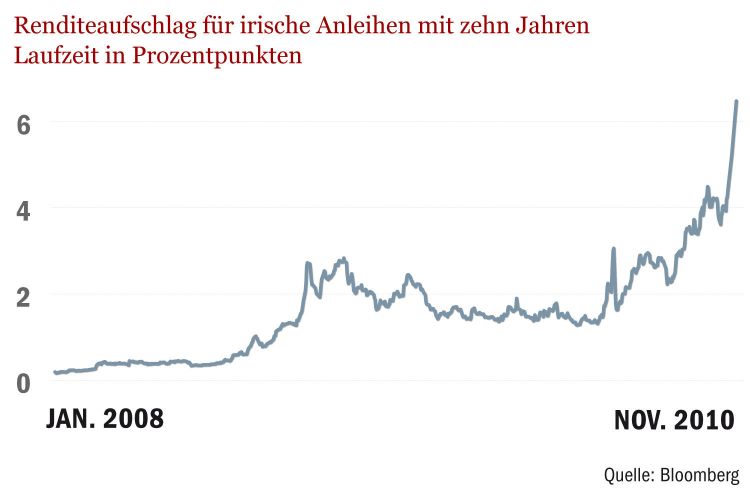
Die Skepsis vieler Investoren gegenüber Staatsanleihen aus Irland und anderen hoch verschuldeten Ländern der Euro-Zone ist am Donnerstag weiter gewachsen. In der Folge gab der Euro auf bis zu 1,3657 Dollar von 1,3780 Dollar zum US-Vortagesschluss nach. Müssen die europäischen Steuerzahler nach Griechenland bald auch Irland vor dem Bankrott retten? In hohen EU-Kreisen wächst die Nervosität über die Risikoaufschläge für irische Staatsanleihen, die gestern mit 680 Basispunkten für zehnjährige Bonds zur Bundesanleihe ein neues Hoch erreichten.


Foto: Infografik WELT ONLINE Spread: Renditeaufschlag irischer Anleihen im Vergleich zur deutschen Bundesanleihe

Gleichzeitig steigt in vielen EU-Ländern der Unmut über eine von Deutschland und Frankreich geforderte Klausel, ab dem Jahr 2013 private Gläubiger von vornherein bei künftigen Staatspleiten in die Pflicht zu nehmen. „Deutschland hat wieder einmal den großen Mann hervorgekehrt. Das wird für immer mehr Länder zum Problem. Aber gegen Deutschland lässt sich derzeit nichts durchsetzen“, sagte ein EU-Spitzendiplomat. Die Angst privater Gläubiger, künftig an einer Umschuldung beteiligt zu werden, hat dazu geführt, dass sich viele Anleger von Anleihen aus Irland, Portugal, Spanien und Italien verabschieden. Der Chef der Europäischen Zentralbank (EZB), Jean-Claude Trichet, und der Vorsitzende der 16 Euro-Länder, Luxemburgs Premierminister Jean-Claude Juncker, hatten noch beim EU-Gipfel Ende Oktober vor dieser Entwicklung gewarnt. „Die Märkte reagieren jetzt völlig irrational. Aber sollte keine Ruhe einkehren, werden wir an einer Hilfsaktion für Irland nicht vorbeikommen“, heißt es in Brüssel.

Der von EU und Internationalem Währungsfonds (IWF) aufgespannte Rettungsschirm für Pleiteländer der Euro-Zone umfasst 750 Mrd. Euro. „Wir haben alle nötigen Instrumente, um Irland zu unterstützen, falls dies nötig sein sollte“, sagte EU-Kommissionschef Jose Manuel Barroso gestern beim Treffen der G-20-Staaten im südkoreanischen Seoul. Die Märkte beruhigte er damit nicht. Der Euro fiel auf bis zu 1,3657 Dollar. Irlands Finanzminister Brian Lenihan sagte, er werde „auf keinen Fall“ einen Hilfsantrag nach Brüssel schicken. Milliarden-Ausgaben zur Rettung heimischer Banken haben Irland in diesem Jahr ein Rekorddefizit von 32 Prozent des Bruttoinlandsprodukts (BIP) beschert. Nach eigenen Angaben muss das Land bis zu 50 Mrd. Euro zur Rettung von Banken ausgeben. „Dabei ist leider überhaupt nicht sicher, dass die Banken damit gerettet sind und im kommenden Jahr nicht wieder hohe Milliarden-Beträge nötig sein werden“, sagte ein EU-Beamter voller Sorge. Dennoch versicherte die Regierung in Dublin, das Land sei in der Lage, seinen angeschlagenen Haushalt aus eigener Kraft in den Griff zu bekommen.

Stabilitätspakt – was sich ändert, was bleibt

Staaten, die 1999 den Euro einführen wollten, mussten gewisse Kriterien erfüllen. Auf Drängen des deutschen Finanzministers Theo Waigel (CSU) beschloss die EU schon 1996, zwei davon den Ländern zur Dauer-Auflage zu machen, um die Stabilität der Währung zu sichern:

Auch in Berlin wurde beruhigt. Irland und Portugal seien dabei, ihre Haushalte in Ordnung zu bringen, hieß es aus dem Bundesfinanzministerium (BMF). Es gebe kein Anzeichen, dass sie einen Hilfsantrag stellen müssen. Zudem wurde darauf verwiesen, dass Irland bis Mitte 2011 kein neues Geld am Kapitalmarkt aufnehmen muss. „Der Markt ist trotzdem sehr nervös“, sagte Markit-Analyst Gavan Nolan. 20 von 30 durch die Nachrichtenagentur Reuters befragte Analysten erklärten, sie rechneten mit einem irischen Hilfsgesuch bis Ende 2011. Aber nicht nur Irland – wo allein deutsche Banken gegenüber Staat, Banken, Unternehmen und den privaten Haushalten 138 Mrd. Dollar an Forderungen halten – bereitet den Märkten zunehmend Kopfzerbrechen.

Auch die Zweifel an der Zahlungsfähigkeit Portugals – dessen strukturelle Wirtschaftsprobleme viel größer sind als in Irland – steigen. Der Spread der zehnjährigen Titel stieg im Vergleich zu den entsprechenden Bundespapieren auf ein erneutes Rekordhoch von 489 Basispunkten.

Griechenland Regierungschef Giorgos Papandreou teilte unterdessen mit, dass die Neuverschuldung Griechenlands in diesem Jahr höher ausfallen werde als zunächst vereinbart. Sein Land werde das Defizitziel von 8,1 Prozent des BIP überschreiten, sagte der Premierminister. Schlechte Nachrichten auch vom Arbeitsmarkt: Die Erwerbslosenquote stieg auf 12,2 Prozent, ein Rekordhoch. Die EU-Länder und der IWF hatten Griechenland Anfang des Jahres 110 Mrd. Euro Kredithilfen zugesagt.

Euro Drops as Spain Economy Stalls, Irish Debt Concern Lingers

Euro Drops as Spain Economy Stalls, Irish Debt Concern Lingers

Euro Drops as Spain Economy Stalls, Irish Debt Concern Lingers

Nov 11, 2010 7:33 am ET

Nov. 11 (Bloomberg) -- The euro slid against the dollar and yen as France backed German calls to make investors share the costs of restructuring sovereign debt, Spain’s economy stalled and Ireland’s fiscal crisis drove down bank stocks.

The single currency declined versus 13 of its 15 most- traded peers, and approached the lowest in more than a month versus the greenback. The Dollar Index advanced for a fifth day, its longest run of gains since August, amid renewed concern that Europe’s so-called peripheral countries will struggle to cut budget deficits. The pound rose to a six-week high against the euro, boosted by speculation the Bank of England won’t extend its bond-purchase program.

“The focus is on the euro and what’s happening in the periphery,” said Daragh Maher, deputy head of global foreign- exchange strategy at Credit Agricole Corporate & Investment Bank in London. “We are at a critical point for the euro.”

The euro traded at $1.3709 at 6:51 a.m. in New York from $1.3783 yesterday, when it declined to $1.3671, its weakest since Oct. 5. Europe’s common currency slipped to 112.75 yen from 113.41 yesterday. The dollar was unchanged at 82.28 yen.

“All stakeholders must participate in the gains and losses of any particular situation” as a “point of principle,” French Finance Minister Christine Lagarde said during an interview with Bloomberg Television’s “On the Move” with Francine Lacqua.

Spain, Ireland

Spain’s third-quarter gross domestic product was unchanged from the previous three months after two quarters of growth, state statistics showed, as the nation implements the deepest austerity measures in three decades. The extra yield investors demand to hold 10-year Spanish bonds instead of German bunds climbed to 215 basis points today, the most since June.

Stoxx Europe 600 bank shares slid for a second day, paced by a 9.1 percent drop by Bank of Ireland, the nation’s largest lender. Irish debt spreads over German bunds surged to a record, a day after bond-clearing house LCH Clearnet Ltd. demanded clients place larger deposits when trading the nation’s debt.

European Union members are checking whether Ireland needs financial aid from a 750 billion-euro rescue fund, Handelsblatt said today, citing government officials it didn’t identify. Ireland hasn’t yet requested aid, the report said.

Europe’s common currency has lost 1.1 percent against nine developed-nation counterparts in the past week, Bloomberg Correlation-Weighted Currency Indexes show. The currency has dropped amid bets that the fiscal crisis in the region and potential bank losses will force the central bank to reverse plans to exit its stimulus measures.

Exit ‘in Tatters’

The “ECB exit strategy in tatters means strong euro story in tatters too,” Kit Juckes, London-based head of foreign- exchange research at Societe Generale AG, wrote in an e-mail today. “The ECB’s exit strategy drove euro rates and the currency. Even central banks don’t always get what they want for Christmas.”

IntercontinentalExchange Inc.’s Dollar Index, which tracks the currency against those of six major U.S. trading partners including the euro, rose 0.3 percent to 77.886. The dollar benefits from its status as a haven from financial turmoil.

The British pound gained 0.6 percent to 84.96 pence per euro, after trading at 84.88 pence, the strongest level since Sept. 28. It was 0.1 percent stronger at $1.6138.

The Bank of England, led by Governor Mervyn King, yesterday unveiled higher predictions for inflation next year and said prices are equally likely to exceed or undershoot the 2 percent target over two years. The bank also said it “stood ready to respond in either direction.”

Faster Gains

The dollar weakened earlier against most of its major counterparts after China’s yuan rose to the strongest level since 1993, fueling speculation the Asian nation is allowing faster gains as Group of 20 leaders meet in Seoul.

G-20 nations including China are trying to forge an agreement on currencies that goes beyond an accord reached by finance ministers and central bank governors last month, the group’s committee spokesman Kim Yoon Kyung said in Seoul today.

Finance ministers agreed in October to “move towards more market-determined exchange rate systems that reflect underlying economic fundamentals and refrain from the competitive devaluation of currencies.” G-20 leaders are gathering for a two-day summit starting today.

The U.S. currency slipped 0.2 percent to 6.6238 yuan.

--With assistance from Emma Ross-Thomas in Madrid, Ron Harui in Singapore and Monami Yui in Tokyo. Editors: Mark McCord, Peter Branton.