Blogia

MATEO MATHAUS: THE WORLD NOW

Spain :The bailout Costs of the big elephant.

Spain :The bailout Costs of the big elephant.


Bailout Costs

Spanish bonds extended declines after the Financial Times Deutschland reported that the European Central Bank and a majority of euro-region states are calling on Portugal to tap the rescue fund to prevent Spain from also having to seek help. That followed comments from Bundesbank President Axel Weber late on Nov. 24 that if the 750 billion-euro rescue fund isn’t enough to reassure markets, “it will have to be increased.”

Steven Major, global head of fixed-income research at HSBC Holdings Plc in London, said in a Nov. 8 report that the fund, financed by the EU and International Monetary Fund, may not be sufficient.

In practice, the EU may only be able to deploy 367 billion euros of its 440 billion-euro share of the European Financial Stability Facility, he says. That’s because the EFSF will raise the money for the bailouts by issuing bonds and must set aside a cash pile to secure a AAA credit rating, Major said. A three- year bailout of Portugal would require 51.5 billion euros and Spain would need 351 billion euros, HSBC said.

“The big elephant in the room is Spain, which is too big to fail and too big to be bailed out,” Nouriel Roubini, the New York University professor who predicted the global financial crisis, said in an interview Nov. 23. “In some sense though, Spain is in a better place.”

Too Big to Bail?

Asked whether its size would deter an EU bailout, Bank of Spain chief economist Jose Luis Malo de Molina said late yesterday that “the systemic importance” of a country like Spain “reinforces the incentives and stimuli for the rest of the countries to be ready to help in the case that it were necessary.” He said market tensions can become a “self- fulfilling prophecy.”

The Spanish government, which has repeatedly ruled out external help, doesn’t face the first of its 45 billion euros in bond redemptions next year until April. It has two more bond auctions scheduled for December, and Deputy Finance Minister Jose Manuel Campa said in an interview Nov. 24 that spending cuts and higher-than-forecast revenue make the government’s funding “quite comfortable.”

Campa says there’s no need for additional measures to stem contagion and instead Spain must show its commitment to implementing the budget cuts and structural changes already announced to reduce the deficit to 6 percent of GDP next year from 11 percent in 2009. The target is “unconditional,” he said.

New York Times : A Spanish Bailout Would Test Europe’s Strained Finances

New York Times : A Spanish Bailout Would Test Europe’s Strained Finances

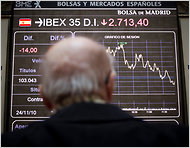
 A Spanish Bailout Would Test Europe’s Strained Finances By RAPHAEL MINDER Published: November 24, 2010 * Recommend * Twitter * Sign In to E-Mail * Print * Single Page * Reprints * ShareClose o Linkedin o Digg o Mixx o MySpace o Yahoo! Buzz o Permalink o MADRID — Europe so far has survived the bailout of Greece. The financial rescue of Ireland also is manageable. Even if Portugal becomes the third country to succumb and seek aid, as many people widely predict, it is unlikely to push Europe to the financial brink. Enlarge This Image Daniel Ochoa De Olza/Associated Press A broker on the floor of the stock exchange in Madrid on Wednesday. Enlarge This Image Juanjo Martin/EFE, via European Pressphoto Agency Elena Salgado, Spain’s finance minister, right, and Alfredo Pérez Rubalcaba, a deputy prime minister, at a meeting about employment this month. But any bailout of Spain — with an economy twice the size of the other three combined — could severely stress the ability of Europe’s stronger countries to help the financially weaker ones, and spell deep trouble for the euro, Europe’s common currency. Even though Spain, like Ireland, has adopted an austerity plan to help it avoid the need for a bailout, it still could need aid if its banking system proves frailer than the government thinks it is, as was the case in Ireland. This troubling possibility has unnerved lenders, with Spain’s borrowing costs rising even though Madrid has cut its deficit and the country’s banks maintain they have sufficient strength to absorb their bad real estate loans. “Europe can afford the collapse of Ireland, even perhaps that of Portugal, but not that of Spain, so Spain’s ultimate line of defense is in fact this knowledge that it’s too big to fail and that it represents a systemic risk for the euro,” said Pablo Vázquez, an economist at the Fundación de Estudios de Economía Aplicada, a research institute here. Reflecting the worries of investors, the yield spread between Spanish 10-year government bonds and those of Germany continued to widen on Wednesday — to as high as 2.59 percentage points, the biggest gap since the introduction of the euro. Spreads typically widen when investors perceive greater risk of not being repaid. The problem for Spain is one of “self-fulfilling expectations,” said Jordi Galí, director of the Center for Research in International Economics at Barcelona’s Pompeu Fabra university. “If investors expect Spain to have trouble refinancing its debt, now or somewhere down the road, then Spain will have trouble,” he added. “This is only aggravated by the fact that the reluctance of investors to purchase the country’s public debt leads to an increase in the interest rate it has to pay and thus in the budget deficit and the amount of debt it has to issue.” Elena Salgado, Spain’s finance minister, insisted on Wednesday that Spain would not need rescuing. She told Spanish radio that “we are in the best position to resist against these speculative attacks.” Indeed, some say that one of Spain’s relative strengths is that a large amount of its government debt — 203.3 billion euros ($271.1 billion) — is owed to its own banks, rather than foreign lenders. If the government’s financial condition worsens, the thinking goes, Spanish banks would have a greater incentive to help out by easing terms on the loans than would foreign banks, which might take a harder line. Of course, it is a bit of a double-edged sword; if the Spanish banks need to ease terms to help the government, they could be forced to swallow steep losses, hurting their balance sheets. The likelihood of entering such a vicious circle could also rise next year, when Spain is due to repay lenders 192 billion euros, or about a fifth of the total debt. As a result of increasing interest it would have to pay for new borrowing, Spain faces a rise of 18 percent in the cost of financing its debt, according to the government’s budgetary plan. Investor nervousness is mounting just as Madrid is reining in a budget deficit that reached 11.1 percent of gross domestic product last year. Prime Minister José Luis Rodríguez Zapatero, initially slow to recognize the crisis, narrowly pushed through Parliament last May an austerity package that included 15 billion euros of spending cuts. As a result, Spain’s central government deficit fell 47 percent in the first 10 months of this year, according to government figures released on Tuesday. Ireland also made steep spending cuts, but still needed a bailout. The main reason is that its banks were a lot more troubled than the government realized, and it could not afford the cost of supporting them without help from Europe. The looming question is whether Spanish banks are really as healthy as the government and the banks say they are.

Irish Bonds Lead Spanish, Portuguese, Greek Debt Lower on S&P.

Irish Bonds Lead Spanish, Portuguese, Greek Debt Lower on S&P.

Nov 24, 2010 11:26 am ET

Nov. 24 (Bloomberg) -- Irish bonds led declines by the euro region’s most indebted members after a two-notch sovereign downgrade by Standard & Poor’s deepened concern the nation’s fiscal crisis will spread.

Spanish and Greek securities fell after Ireland’s credit was lowered to A from AA- by S&P, which cited the mounting cost of bailing out the nation’s banks. German bonds slid after demand weakened at a sale of new 10-year debt and stock markets rose. Portuguese bonds declined as workers walked out in the nation’s biggest strike for 22 years. Irish bonds stayed lower after Ireland announced a budget plan to stave off bankruptcy.

“There’s a lot of fear and concern,” said Michael Leister, a fixed-income analyst at WestLB AG in Dusseldorf, Germany. “The key issue is if, or by how much, Spain will get dragged into this. Ireland and Portugal are manageable in terms of cost. The market is worried that, given the size of Spain, it’s a different animal.”

Irish 10-year yields jumped 48 basis points to 9.12 percent at 4:19 p.m. in London. The 5 percent security due October 2020 tumbled 2.52, or 25.20 euros per 1,000-euro ($1,337) face amount, to 73.85 Portuguese 10-year yields advanced 12 basis points to 7.18 percent.

Similar-maturity Spanish yields climbed 17 basis points to 5.09 percent, while German 10-year yields rose 10 basis points to 2.65 percent. The difference in yield, or spread, between Irish and German 10-year yields widened 31 basis points to 617 basis points, according to Bloomberg generic data, while the Spanish-German spread was one basis point wider at 235 after reaching a record 249.

Bank Injections

The euro strengthened 0.1 percent to $1.3374, trimming this week’s drop to 2.2 percent. The Stoxx Europe 600 Index of shares climbed 1.1 percent. U.S. 10-year Treasury yields gained 11 basis points to 2.88 percent.

Ireland’s government said it will cut spending by about 20 percent and raise taxes over the next four years as talks with the International Monetary Fund and the European Union over a bailout of the country near conclusion.

Welfare cuts of 2.8 billion euros and income-tax increases of 1.9 billion euros are among the steps planned to narrow the budget deficit to 3 percent of gross domestic product by the end of 2014. The shortfall will be 12 percent of GDP this year, or 32 percent including a banking rescue.

The EU-IMF rescue package may be about 85 billion euros, Prime Minister Brian Cowen said today.

German Debt Sale

Germany sold about 4.8 billion euros of 2.5 percent bonds maturing in January 2021 at an average yield of 2.59 percent. Investors bid for 1.2 times the securities issued, the lowest so-called bid-to-cover ratio for a 10-year auction since February 2009.

“The auction in Germany and the strong negative tone in the U.S. Treasury market helped push up German yields,” said Patrick Jacq, a senior fixed-income strategist at BNP Paribas SA in London. “There’s been some profit taking after yesterday’s strong rally.”

German bonds also fell as a report showed business confidence in Europe’s largest economy unexpectedly surged to a record in November. The Munich-based Ifo institute said its business climate index, based on a survey of 7,000 executives, increased to 109.3 from 107.7 in October. Economists predicted a decline to 107.5, according to a Bloomberg News survey.

S&P’s cut leaves Ireland’s debt five steps above Greece, which has the highest junk, or high-risk, classification. Ireland may be lowered again, the ratings company said. Moody’s Investors Service said two days ago that a “multi-notch” downgrade in Ireland’s credit rating was “most likely” because the bailout would increase the nation’s debt burden.

Collective Action

“The Irish government looks set to borrow over and above our previous projections to fund further bank capital injections into Ireland’s troubled banking system,” S&P said in a statement late yesterday. The fact the debt may be lowered again reflects the risk that talks on an EU-led rescue may fail to staunch capital flight, it said.

German Chancellor Angela Merkel wants buyers of new euro- region bonds to accept liability clauses starting in 2011, two years before a revamped crisis-management system kicks in, a government document shows. The “blanket” introduction of standardized collective-action clauses for all government bonds issued in the 16-nation euro region would be “unproblematic” and should begin next year, according to the Finance Ministry document, a copy of which was obtained by Bloomberg News.

Bonds of Ireland, Portugal and Greece have slumped since EU leaders agreed on Oct. 29 to consider Germany’s proposal for a permanent rescue mechanism as of 2013. The plan would involve debt restructuring, with losses for private investors in sovereign bonds.

Banks Plunge

“Day by day, we are getting fresh details of the German proposal and this is impacting the market today,” said Kornelius Purps, a fixed-income strategist at UniCredit SpA in Munich. “There is little reason to become more optimistic on the periphery at this point.”

Irish bonds also fell as the government prepared to inject more capital into Bank of Ireland Plc, the nation’s largest bank, a step that may make it the fifth lender to fall under majority state control in less than two years.

Shares in Bank of Ireland, already 36 percent owned by the state, fell 9.3 percent in Dublin, after sinking as much as 37 percent. Allied Irish Banks Plc, the second-largest lender, which already faces the prospect of more than 90 percent state ownership, slid as much as 24 percent.

ECB Borrowing

Euro-region banks borrowed 38.2 billion euros from the European Central Bank in 91-day loans today, double the 19.1 billion-euros expiring. Economists expected them to ask for 29 billion euros, according to the median of eight forecasts in a Bloomberg News survey.

“The increase is probably due to the fact that Irish, Portuguese and Greek banks increased their positions, most likely, in our view, for precautionary reasons because of the current tough market situation,” Giuseppe Maraffino, a fixed- income strategist at Barclays Plc in London, wrote in a research report today.

Portugal led a jump in the cost of insuring against default on European sovereign debt, according to traders of credit- default swaps.

Contracts on Portuguese government bonds were at 481 basis points, down from 487 yesterday, according to data provider CMA in London. Swaps on Ireland were little changed at 575, Spain slipped 3 basis points to 298, and Greece dropped 43 basis points to 977.

EU policy makers must show “meaningful actions” to head off a “spreading disaster” in the euro region, said Mohamed El-Erian, chief executive officer at Pacific Investment Management Co.

Ireland is getting “uncomfortably close to a devastating banking crisis that would derail growth, employment and wealth creation for a whole generation,” El-Erian wrote in an article for the Financial Times.

--With assistance from Abigail Moses in London. Editors: Daniel Tilles, Keith Campbell

Ireland Becomes Second Euro Nation to Seek Aid

Ireland Becomes Second Euro Nation to Seek Aid

Ireland Becomes Second Euro Nation to Seek Aid

Nov 22, 2010 8:31 am ET

(Adds Green Party in paragraph two.)

Nov. 22 (Bloomberg) -- Ireland became the second euro country to seek a rescue as the cost of saving its banks threatened a rerun of the Greek debt crisis that destabilized the currency.

The euro erased gains and Irish bonds pared an early advance after Moody’s Investors Service said a “ multi-notch” downgrade in Ireland’s Aa2 credit rating was “most likely.” The prospect of January elections loomed as the Green Party said it would pull out of Prime Minister Brian Cowen’s coalition.

A package that Goldman Sachs Group Inc. estimates may total 95 billion euros ($130 billion) failed to damp speculation that Portugal and Spain would need to tap the emergency fund set up by the European Union and International Monetary Fund after the Greece rescue.

“It probably won’t halt contagion. The sovereign crisis isn’t yet over,” said Sylvain Broyer, chief euro-region economist at Natixis in Frankfurt. “Ireland is in the middle of a difficult crisis.”

The aid, which Irish officials said as recently as Nov. 15 they didn’t need, marks the latest blow to an economy that more than doubled in the decade ending in 2006. The bursting of the real-estate bubble in 2008 plunged the country into a recession and brought its banks close to collapse. With Irish bond yields near a record high, policy makers are trying to keep the crisis from spreading.

Threat to Euro

“Clearly because of the size of their loan books, the huge risks they took, they became a threat not only to the state but to the” entire euro region, Finance Minister Brian Lenihan told Dublin-based RTE radio in an interview today. “The banks will be downsized to the real needs of the Irish economy” to “Irish consumers and Irish businesses. That has to be the primary focus of Irish banks.”

The euro slid 0.3 percent to $1.3633 at 1:30 p.m. in London. The yield on Irish 10-year notes fell 5 basis points to 8.30 percent after falling as low as 8.11 percent.

The U.K. and Sweden may contribute bilateral loans, the EU said in a statement. Lenihan declined to say how big the package will be, saying that it will be less than 100 billion euros. Goldman Sachs Chief European Economist Erik Nielsen said yesterday the government needs 65 billion euros to fund itself for the next three years and 30 billion euros for the banks.

Deficit, Banks

Talks will focus on the government’s deficit cutting plans and restructuring the banking system, the EU said in a statement. Cowen who spoke at the same press briefing as Lenihan, said the banks will be stress tested. Ireland nationalized Anglo Irish Bank Corp. in 2009 and is preparing to take a majority stake in Allied Irish Banks Plc, the second- largest bank.

Irish banks may get immediate capital injections, Matthew Elderfield, the country’s head of financial regulation, said in a speech today. The country’s two biggest lenders need at least 5 billion euros immediately, Ciaran Callaghan, an analyst with NCB Stockbrokers, wrote in a note to clients on Nov. 18.

The package for Ireland will total as much as 60 percent of gross domestic product, compared with 47 percent for Greece.

Cowen plans to announce the government’s four-year budget plan this week and said an agreement with the EU and the IMF will come “in the next few weeks.”

The Green Party said today it will quit the government after the budget is passed, leaving Cowen without a majority in parliament. Irish voters “feel misled” by the government, leader John Gormley said at a press conference in Dublin.

No ‘Bogeyman’

Irish officials initially resisted pressure from the EU to take any aid, saying they were fully funded until the middle of 2011. European leaders sought to head off contagion from Ireland and reduce pressure on the European Central Bank to prop up the country’s lenders by providing them with unlimited liquidity.

Cowen defended his reversal on the need for aid. “I don’t accept I’m the bogeyman,” he said. “Now circumstances have changed, we’ve changed our policies.”

The bailout follows two years of budget cuts that failed to restore market confidence as the cost of shoring up the financial industry soared.

Lenihan cancelled bond auctions for October and November and announced 6 billion euros of austerity measures for 2011 on Nov. 4 in a bid to restore investor confidence. Those efforts failed after German Chancellor Angela Merkel triggered an investor exodus by saying bondholders should foot some of the bill in any future bailout.

Irish Spread

The risk premium on Ireland’s 10-year debt over German bunds, Europe’s benchmark, fell to 523 basis points today. It widened to a record 652 basis points on Nov. 11, with the yield reaching a record 9.1 percent. In 2007, it cost Ireland less than Germany to borrow. Its 10-year spread then fell to as low as 77 basis points less than bunds. The ISEQ stock index has plunged 70 percent from its record in 2007.

Ireland will draw on the 750-billion-euro fund set up by the EU and IMF in May as part of the Greek bailout to protect the currency shared by 16 countries.

Yields on bonds of Spain and Portugal have jumped amid concern that fallout from Ireland would spread. The extra yield that investors demand to hold Portuguese 10-year bonds instead of German bunds climbed to a record 484 basis points on Nov. 11.

“Speculative actions against Portugal and Spain are not justified, though it can’t be excluded,” Luxembourg Prime Minister Jean-Claude Juncker said today on RTL Luxembourg radio. “In a moment where financial markets have an excessive tendency to punish those countries that didn’t stick 100 percent to an orthodox consolidation, one can never exclude that similar things will happen.”

--With assistance from Finbarr Flynn in Dublin, Simone Meier in Zurich, Boris Groendahl in Vienna, Jones Hayden in Brussels, Sandrine Rastello in Washington, Alisa Odenheimer in Jerusalem and Stephanie Bodoni in Brussels. Editors: James Hertling, Fergal O’Brien

La Hiperinflacción ,su cercanía y sus consecuencias.

La Hiperinflacción ,su cercanía y sus consecuencias.

¡Cuidado, la inflación tiene ancas de rana! Decálogo para estar preparado


A la verdad la llevan al matadero todos los días. La mentira recibe todas las atenciones y cuidados posibles y a la verdad la asesinan diariamente, en silencio. Y en ese silencio...


@Ricardo Santos - 20/11/2010 06:00h

Un monje que cambió su Ferrari por un pedazo de queso dijo una vez que si echamos una rana en una cazuela con agua excesivamente caliente, el anfibio percibirá el peligro y saltará inmediatamente para ponerse a salvo. Caso contrario, si la situamos en agua tibia y subimos la temperatura gradualmente… entonces el anfibio se quedará chapoteando tranquilamente, y acostumbrándose al cambio de temperatura, acabará por morir hervido.


Lo cierto es que, aunque no lo percibamos, los gobiernos suelen cocinarnos a los ciudadanos al fuego lento de la inflación, aumentando su liquidez en detrimento de nuestros ahorros. Gracias a esta inflación monetaria (la que no proviene de las preferencias de los consumidores y del ciclo económico), cada unidad de dinero vale menos con el paso del tiempo, lo que ayuda a llevar (encubiertamente) de una forma más liviana y apacible la carga del erario público.

 
En 1956 Philip Cagan estableció la definición clásica de hiperinflación: una subida mensual de más del 50% en precios (lo que equivale a un impresionante 12.875% anual). Está claro que en este escenario tercermundista, el valor del dinero se pierde antes de que la tinta se seque en los billetes (de muchos ceros) y la mejor inversión es una escopeta. Sin querer ser agoreros, ni llegar a esos extremos, creemos que es conservador prepararse para una versión mucho más diluida (pero no por ello menos peligrosa) de un shock de precios (una subida de precios súbita que genere una devaluación de la divisa y una subida de los tipos de interés, que es lo que sucede en la mayoría de estos casos), aunque tampoco sea nuestro escenario central.


Simplemente creemos conveniente establecer un pequeño decálogo de urgencia para estar preparados. Por si las moscas.  

   1.
      La primera regla de un escenario de inflación elevada es que un euro hoy es menos que un euro mañana por aumento del coste de la vida.
   2.
      La segunda regla es que un euro hoy es menos que un euro mañana también por el mero lapso temporal. El tiempo se come el dinero.
   3.
      Dos palabras: activos tangibles. Enfocarse en preservar el patrimonio. Invertir en sectores o bienes duraderos. Invertir en activos que pervivan y/o que vayamos a utilizar de todos modos y que sirvan durante mucho tiempo.
   4.
      Pensar en términos reales y en el largo plazo. Invertir pensando en el largo plazo, y sin dejarse engañar por la inflación: las inversiones a corto plazo darán resultados distorsionados (parecerán ofrecer beneficios, mientras que en realidad estamos teniendo pérdidas).
   5.
      Intentar, en la medida de lo posible, mantener el dinero en divisas que no vayan a devaluarse.
   6.
      Respecto al ahorro: en un shock de inflación el crédito se vuelve más escaso y caro (los inversores exigen más). Esto conlleva varias lecturas. Una, negociar duro los depósitos y conseguir una alta remuneración, para al menos en parte, seguir el ritmo de la inflación. La diversificación de depósitos en diferentes bancos es una buena idea ya que algunos bancos probablemente quebrarán. Dos, negociar una tasa fija aceptable para las deudas (si es posible) o liquidarlas (el coste de vida y los intereses subirán, haciendo más difícil el  servicio de la misma). Y tres, en la medida de lo posible pagar en cash (valdrá menos).
   7.
      Respecto a la inversión... Uno, tener cuidado con la compra de bonos: las altas tasas de inflación pueden destruir completamente el valor de los bonos a largo plazo (básicamente, una segunda derivada de pensar en términos reales, no nominales); y dos, saber, por el contrario, que la renta variable y los activos reales constituyen un buena protección sobre la inflación a largo plazo.
   8.
      No pensar en costes históricos. En tiempos de inflación elevada, no se funciona con LIFO o FIFO, si no con NIFO (Next In First Out), lo que importa no es lo que se ha pagado en el pasado, es el coste de reposición futuro.
   9.
      Ampliar el círculo de suministradores de capital (recordemos, crédito estrecho y caro), lo que incluye a establecer lazos con clientes y suministradores para dar mercado a los clientes y facilitar nuestras compras y las suyas.
  10.
      Vivir de manera racional: pensar en la cantidad y la frecuencia con que se necesita algo y luego comprar lo que se necesite, gastando en los no-recurrentes con moderación.   

Puede sonar a advertencia taciturna y alarmista. Como en el cuento de Pedro y el lobo, la reiteración de una amenaza que no se materializa pasa de ser considerada un elemento real a un simple desvarío. Lo mismo sucede con la inflación elevada… Hasta que un día llega. Y salta. Después de todo, la inflación también tiene ancas de rana.

Ireland in last-minute bid to avoid stigma of bank bailout

Ireland in last-minute bid to avoid stigma of bank bailout

By Fionnan Sheahan
Friday, 19 November 2010

The Irish government has drawn up a last-ditch plan to avoid being forced to accept an EU bank bailout.

It wants to borrow money for the banks — supported by a guarantee from the European Central Bank.

That would mean technically avoiding a bailout and the politically damaging perception of a loss of sovereignty.

However, it would also risk alienating EU leaders who are convinced the government should take the bailout and get on with restoring the public finances.

And regardless of what sort of ‘bailout’ eventually emerges there will be strict budgetary conditions attached and the government will have to enforce a draconian budget next month.

The revelation came as a high-powered delegation from the European Commission, the European Central Bank (ECB) and the International Monetary Fund (IMF) arrived in Dublin yesterday to begin negotiations on a deal to restore confidence in the economy.

Mergers, nationalisation and the forced sales of banks will all be on the table when European officials sit down to debate a potential EU bailout for the sector.

Irish Finance Minister Brian Lenihan is also coming under fresh pressure to raise Ireland’s corporation tax rate, vital to keeping over 100,000 jobs.

The government’s counter-proposal would involve Ireland borrowing billions on the markets to support the ailing banks itself, possibly with the help of its European partners.

If Dublin could raise the money at a low rate of interest instead of accepting a bailout from the EU, Taoiseach Brian Cowen and his ministers could continue to run the country and not be forced to hand over control to the IMF.

It has been learned discussions around achieving this solution are continuing. It could only work with the EU providing some form of support or guarantee on Ireland’s ability to repay its debts.

Mr Cowen continued to insist last night that Ireland was not in talks on a bailout for the country.

“We haven’t started any negotiations. I want to get away from this word game,” he said.

A spokesman for Brian Lenihan said the Government would “wait and see where the discussions lead to”


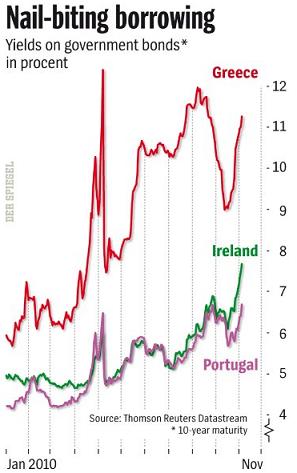
Der Spiegel :Portugal -Spanien - Griechenland: Allianz der Finanzschwachen

Euro-Krise

Europa wird zum Finanz-Schlachtfeld

Von Sebastian Fischer und Florian Gathmann

Foto: AP

Portugal -Spanien - Griechenland: Allianz der Finanzschwachen


Zur Großansicht
DPA

Athen hat zwar schon eine Rettungsaktion hinter sich - aber gerettet ist Griechenland trotz der Milliarden-Hilfen der EU-Mitglieder noch lange nicht. Für die Griechen geht es darum, so schnell wie möglich wieder kreditwürdig zu sein und damit auf eigenen Füßen stehen zu können. Darum kämpfen zurzeit auch die Nachbarländer Spanien und Portugal, die viele Experten neben Irland als Krisen-Kandidaten der EU ausgemacht haben.

Was Athen, Madrid und Lissabon eint: Sie sind sauer auf Kanzlerin Merkel, weil sich die Bundesregierung für eine künftige Gläubigerbeteiligung im nationalen Krisenfall ausgesprochen hat - was ihrer Meinung nach die Zinsen für Staatsanleihen in die Höhe treibt.

Nicht ganz auf einer Linie sind die drei Länder dagegen in der Irland-Frage: Portugal und Spanien sind für rasche Hilfen, weil sie im Fall des irischen Kollapses ein Überschwappen der Krise auf ihre Volkswirtschaften fürchten, und machen deshalb massiv Druck auf Dublin. Diese Sorgen muss man sich in Griechenland nicht mehr machen. Dort ist längst Krise

I did not mislead public on Ireland bailout talks, says Irish PM Brian Cowen.

By Fionnan Sheahan and Patricia McDonagh
Thursday, 18 November 2010

Taoiseach Brian Cowen gives his reaction to the reports on the banking crisis at Government Buildings in Dublin.

Taoiseach Brian Cowen gives his reaction to the reports on the banking crisis at Government Buildings in Dublin.

Taoiseach Brian Cowen last night dismissed claims he had misled the Irish public on bailout talks as he struggled to contain a growing backlash on his handling of the crisis.

Tensions rose within the Coalition last night with both Green Party and Fianna Fail backbenchers critical of the Government's public comments on the bailout.

The Greens have remained quiet over the past five days as their Fianna Fail counterparts denied the Government was engaged in any talks on a bailout.

Mr Cowen resorted to shooting the messenger and blaming the media as the Irish government's credibility came under fire.

After blaming the international media earlier in the week, he turned on the domestic media, claiming organisations were trying "to suggest there is something problematic here".

Mr Cowen insisted he was levelling with the people and protecting the country's interests as discussions continued.

"We haven't started any negotiations. I want to get away from this word game," he said.

But Fianna Fail TD Sean Power said last night the Coalition could not continue to treat the electorate "like fools".

"Last week was a poor one for this Government. We failed our people, treating them as if they could not understand the complexities of the financial situation that we are in," he said.

"We engaged in a game of semantics, where we started trying to play a cute game about words, what they meant or might mean, instead of using the opportunity that was presented to us," he said.

A senior Green Party figure said the basis for being in government was made "much more difficult" by the affair.

Following days of Fianna Fail making spurious claims that reports of the talks were "fiction", Green Party chairman Dan Boyle has indicated there was a breach of trust.

"There is a questioning of trust and an adding to uncertainty that is making the basis for being in government much more difficult," Mr Boyle said.

He subsequently watered down his comments, but it is understood elements within the Greens were not happy with the Government's consistent denials of any talks.

Despite a high-level delegation arriving today, Mr Cowen insisted again yesterday there is no question of the government being involved in discussions on a bailout.

Mr Cowen said "pejorative terms" like 'bailout' did not help the situation.

He said Ireland was working with its European partners on issues that were affecting the euro area and the Ireland.

Mr Cowen confirmed officials from the Irish Department of Finance, the Central Bank and the NTMA would be involved in talks with the European Commission, European Central Bank and the IMF.

Fine Gael leader Enda Kenny said the banking policy of the Government had been a "catastrophic failure".

He said the Europeans and IMF were not coming to say "Hello, keep at it, Brian", and the arrival of the delegation would bring a set of strict conditions.


Read more: http://www.belfasttelegraph.co.uk/news/local-national/republic-of-ireland/i-did-not-mislead-public-on-ireland-bailout-talks-says-irish-pm-brian-cowen-15007216.html#ixzz15e3KgTA6