Iran Having Difficulties Selling Oil

Western sanctions have made it difficult for Iran to receive payments for its oil exports.

Western sanctions have made it difficult for Iran to receive payments for its oil exports.
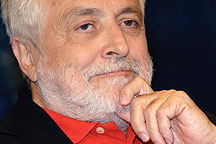
Since it became known that the Oslo-bomber quoted in his muddled manifesto Henryk M. Broder, the journalist is attacked violently. In the interview, defiantly: "I do what I want."
© DPA Henryk M. Broder Thilo Sarrazin He is next to the most prominent critic of Islam in Germany. With his polemical articles pointed to the 64-year-old makes a stir regularly. He has inter alia for "mirror", "World Week" and "Daily Mirror" written since 2011 Broder is the "world" working group. Especially on his own blog, "The Axis of Good" Broder repeatedly denounced the creeping Islamisation in Germany. A few days ago it was announced that the Oslo-bombers Behring Anders Breivik tangled in his manifesto quoted Broder. Since then, the publicist of parts of the press is accused of intellectual arson. Robert Misik called him about the "Taz" an "intellectual complicity."
Broder is currently waiting in Bavaria, where he new episodes of the satirical ARD series "Either Broder - The Germany-safari" around.
Mr. Broder, since it was revealed that the assassin of Oslo has quoted in his manifesto also confused you, you will be attacked in many media and as a "spiritual arsonist" means. In a stern.de article says, they showed "every, of whatever kind complicity in the attacks in Norway on its own." Furthermore you have very excited. Why?
The question is already looking deeply. Is the star a tribunal? You do not need more people's court, if one has the star? What does "He rejects any blame from themselves"? Have you ever wondered also a militant German anti-Zionists like Norman Paech, whether he accepts responsibility for the massacres in Palestine?
Bothers you that you will be taken in connection with the attacks in Norway?
No. What bothers me is that I will explain to the Stooges and copyright. In context, one can do anything.
Ad
They hardly shy away from a public debate and are accustomed to being criticized. Have reached the animosity against you in the past few days, a new dimension?
Selectively I know that already. In this ferocity that is new. There are some people who pay the old bills with me. This is legitimate, fine. The second group needs in their distress and despair a major opponent. And do not sit in Oslo in prison, but lives in Germany. This is something which happens frequently in this society: that we must reduce a complex relationship. You need a scapegoat. When I belonged to a tribe, who invented Christianity, Marxism and psychoanalysis, I am willing to assume the responsibility for it. A few names come before the other hand did not, I have my friends with Leon de Winter and Hamed Abdel-Samad said recently, the two are injured because they are mentioned in the whole complex is not appropriate. Why do all kaprizieren on me, I do not know.
They are after all the most prominent critic of Islam besides Thilo Sarrazin, Germany.
I'm in the Islam debate forward fairly involved, so far there was no way I attach something. Now these mad bombers quoted the Norwegian blogger Fjordman, who in turn quoted me. None of the people who now descend on me, make the effort to perform even a single proof that I said something, the same content as the blogger. I have nothing against mosques and I have nothing against equal rights for immigrants. I would have voted in Switzerland against the ban on minarets. That now all I have to let off steam, some collective psychosis. A portion of the public is simply disengaged. Since each ratio has exposed.
There is also a rational component: Many see the anti-Islamic discourse in Germany generally discredited.
That people who criticize Islam, to be complicit in the assassination, so when I would accuse the star that he was complicit in Palestinian attacks, just because he occasionally friendly reports about Palestinian resistance fighters. This is exactly the same analogy.
However, they hit for years in the same line always: If you have not thus to the hysterization - contributed to the problems of Islam - exist without doubt?
If the other party ceases to pursue cartoons and commit honor killings, then the critics of Islam will cease to criticize Islam. Of course that's always the same line.
Her former colleagues Alan Posener writes: ".. Ideas have consequences Words have consequences not see who wants this relationship, is now not even in leftist circles as to take really seriously." What follows from the set for you?
Of course, words have consequences. The more one knows, but only retrospectively, whether they had consequences. Most words have consequences. Should we therefore say nothing at all - so it is misunderstood in any case? The words of the chairman, Gerhard Schroeder had no consequences, which had by Chairman Mao Tse-tung consequences. But you know, unfortunately, only afterwards. Alan Posener has written a book about the Pope and called him to be dangerous. If you want, you could understand this as a call by Pope assault anyone.
Meanwhile, some newspapers called for moderation in this overheated debate: Your critics should stop, you push the blame for the attacks in the shoes, but you should other critics of Islam and moderate the tone somewhat.
I had to make a suggestion: We do it in a magazine empire chamber, and will set the cornerstone of the debate, may make what is and what is not. As long as this did not happen, I do what I want.
When you write again soon a text on the subject of Islamization in Europe: Will you have a pair of scissors in the head, a little censor who urges more caution in the choice of words?
That's a good question. I hope not.
So far you've been dealt in confrontations and plugged. We never had the impression that you take it personally. Has this changed now?
No, it will not. I sleep well, have continued healthy appetite. Even my sciatic pain has subsided. That must have to do with adrenaline. Incidentally, I'm not a critic of Islam, but a critic of the European policy of appeasement towards Islam.
CAM intervention by the Bank of Spain led by Miguel Angel Fernandez Ordonez socialist (aka MAFO) has set a very bad international investors. Sources in the City of London, which has outraged the big funds and investment banks is not the intervention itself, but the supervisor has expected that the IPO cumpletara Banki to act.
"They knew for months but have been keeping such a problem until they have managed to get Bankia bag, which was all that mattered. Spain as a country has been fatal," said one of these sources. He added that statements by Fernández Ordóñez that no entity needed capital before the CAM intervention have exacerbated the damage.
As reported by The Confidential, the Bank of Spain Alicante inspected the box in December and has since had ample evidence of his state, the breakdown of the Bank Base, the refusal of any entity to purchase the CAM no guarantees, commissioned by the due diligence Ernst & Young FROB and the results of stress tests. However, it has chosen not to do anything at all that time until Bankia was quoted.
"The image we give to foreigners is that we go ready for life and we take them for fools," says a Spanish banker living in London. But clearly no 'school' in the light of the renewed confidence in the accounts of the financial sector, which is leading to more attacks on Spanish banks in exchange.
The sources explained that the City does not explain why Spain did not nationalize their financial system (or at least the boxes) in 2008-2009, like the rest of the world. And the fact that in 2011 we continue intervening entities will show that the problem has been solved and that the only thing that has made the Bank of Spain is a waste of time. One thing that experts agree as reputable as Aristobulus Spanish John.
Investors faced Roldán
The intervention of the CAM is the straw that broke the camel's discrediting of the Bank of Spain to investors, but last Saturday it was clear at a meeting of director general of regulation, José María Roldán, with analysts to explain the stress test . One analyst says the meeting was very tense because analysts snapped at Roldán not believe MAFO statements and needs to inject more capital into the system.
And not just about the savings but also banks, particularly the median, which was not considered able to absorb their losses in brick with current resources. "In Italy, Unicredito all banks have expanded less capital, and no one believes that the Italians and the Spanish capital need not," says a banking analyst.
This distrust has also shown very little in foreign demand in the IPO Bankia and Civic Banking (about 100 million in the first and 72 in the second). A lack of interest is repeated in the case of CAM. "There have been funds that have looked at the box Nomura's hand, but after the stress test and that he expected to Bankia MAFO to intervene CAM, nobody is interested," concludes one of the sources.
The Anti-Jihad Bloggers and Intellectuals Are Responsible.
The Norwegian government’s refusal to deal with the reality of hostile, separatist, un-assimilated, and violent Muslim enclaves in its midst is what finally forced Breivik’s hand. The proof is that Breivik did not murder Muslims. His was a mainly Caucasian-on-Caucasian, infidel-on-infidel, Norwegian-on-Norwegian massacre. Breivik turned on what he viewed as a fifth column, the Norwegian elite. They had the power to insist that Muslim immigrants speak Norwegian and embrace European Enlightenment values. They refused to do so. His message to Norway’s “progressives” is chillingly clear. Their teenage children, already well indoctrinated, will not live to carry out what Breivik viewed as their parents’ failed multi-cultural policies.
Writers work with words; killers write in blood. Breivik could have read all our anti-jihadic work. Like the Dutchman, Geert Wilders, he could have run for public office or launched an educational campaign. True, he would have had to live with being demonized as a racist and criminally sued; ironically, Breivik’s violent approach has led to a similar outcome. Breivik could have made a film about the normalized violence against Muslim-European girls and women at the hands of their families or about the honor killing of Muslim-Norwegian women— but Breivik might have risked the Dutchman Theo van Gogh’s fate and been butchered by an Islamist. Breivik could have penned some fairly innocuous “Mohammed” cartoons, as the Swede Lars Vilks did — but he would have had to live in hiding and with round the clock security. Or, like Lars Langballe, a Danish parliamentarian, he could have spoken his truth and been prosecuted for “hate speech,” just as Elisabeth Sabaditsch-Wolff was in Austria.
There are other ways to “run with” the anti-jihadic expose of how Islamic gender and religious apartheid has penetrated Europe, why this is important, and what is at stake.
Spain: The solution to high unemployment is a "progressive single contract" not new "contract garbage" featuring Rubalcaba ..
Enrik Vázquez & Mateo Mathaus
The current Spanish labor system eliminates the meritocracy and a system that rewards meritocracy is over, at least in the competitive world in which we live.
But if things are as they are for something is not that the Spanish do bad things on a whim. Why protect the worker? On the one hand it is obvious that the power relationship between employee and employer is asymmetrical. But that’s not the most important, at least not from my point of view, since that’s where the problem lies is the lack of productive and existing business culture that tips the balance to one side, a problem that should be covered from another perspective. In my view the protection of workers is also due to the effects of past legislation, it is fair, or I see it, if a worker has helped "build" a company also will be rewarded for it. On the other hand could give examples relating to the "life development" of the person, as it could be more helpful is it to be the father of a family who is not?
We are a young and old, nobody looks at us as "suspects", but recognize that is not the same as a 20 or 30 years lying down, that the protagonist is 50 or 60 and is responsible a great responsibility. It is not the same. Surely there are those who think that person must be 50 to 60 years to save for what might happen, and it is true, but if everyone in Spain was loose at the end of the month and we had high salaries then there is a debate the labor market because everything would be great, but it is not.
Ultimately severance payments are nothing more than a part of wages, so how easy is to simplify, to request the removal, and to increase wages. The problem is that while some workers would benefit, there is an important profile that would not. I do not know if you agree with me but the vital development or merit should not be made conditional on certain profile. However, the measures taken may not be as "brutal" to create a real duality in the labor market and break the meritocracy. In this case all lose because no one standing will be fine.
Solutions.
We need a system to meritocracy, which is not dual, which benefits who do well regardless of their profile. Is there? The current proposals are in two directions. Some propose some sort of hopping single contract, first with "zero" protection and then "low" protection. The other proposed arising from the current failed model without substantial changes to avoid seeing that this is one of the worst systems in the world labor market.
There is a third way, and is now wanted to present: the progressive single contract. From FEDEA long being promoted this concept, I recommend reading what they say about it. And it matches my prior diagnosis or not, opinions are for everyone, it seems to be some consensus on the solution, which is as follows.
As you can guess, the only progressive contract is one where all workers are treated the same, but in which who remains on the company performance is rewarded and who does not (other discussion is the mobility, the Austrian model , etc). Thus, compared to the current situation where some enjoy the benefits and others suffer the consequences, anyone here would have the maximum rights to eight years old, with a great benefit to seniors. The system "does not reward the dismissal" in the first year there would be 12 days per year worked, at 15 seconds if someone is "good" would not pay him out and hire someone simply because they acquired "too many rights "or too much for what the company could afford. This system rewards the hiring, rewards those who remain in the company (and will if he does well) and not cut right. In short this is a model that eliminates the duality and the meritocracy rewards without this is the worker who has to suffer the consequences. Or what is the same, a model that fits perfectly in today’s Spain, the question remains whether he can implement this opinion. Hopefully it.
Carlos Sánchez & Mateo Mathaus
Robert Skidelsky, probably the best known living economist Keynes's work (not as suspicious of liberalism) has recently written a delightful article that says things platitude, but often forgotten by policy makers. Remember that Skidelsky has long been associated with life indebtedness wasteful and apathy, and if a person is in debt, was considered a badge of honor to settle the obligation by selling assets, reducing consumption, working more or a combination of the three things. In fact, they used to pay debts not satisfied by imprisonment. Not through bankruptcy proceedings in which both parties agree on the amount returned.
The same rule was in force for the institutions. Banks were born of a procedure by which gold and silver smiths accepted deposits for safekeeping in exchange for a small fee. When lenders became its oldest rule was to maintain cash reserves equivalent to almost 100% of their deposits. Bankers, thus, avoid being out of funds in the unlikely event that their clients withdraw their money at once. Not at all went to the massive debt (now called leverage).
Such practices, as is known, fell into disuse for some time, but in his writings and Monetary Locke warned that there are only two ways to enrich a country without natural resources (he said 'no mine') through the conquest of territories or through trade. As the first is not always possible (fortunately, we should add), the English thinker recommended the second option. Unfortunately, however, that politicians still think there is a third choice, which is nothing to raise the apparent wealth of the citizens by increasing the debt to unbearable limits.
This is by far the worst of decisions. And not for purely economic reasons, it has to do with the actual quality of the democratic system. When a ruler to his country borrows more than is reasonable (it would be absurd to think that all debt is bad) they really do is defer the tax payment time. Not only that. Hides the nature of public spending, which is profoundly undemocratic.
Through recourse to borrowing, there is no real debate on the amount of taxes to be paid to the State at any time to fund the services needed to meet public demands the community. The paradox can be given even decide that a ruler to cut taxes to win elections by creating a wealth effect among citizens and at the same time, for the backdoor, increase borrowing, which in practice means an increase in the tax burden, but not noticed.
The debt is, in this sense, a painless remedy for the generation that enjoys a level of life that does not apply, and benefits from a volume of benefits is not proportional to the amount of taxes they are willing to pay. Everyone knows that someone will have to repay these debts, but hides that fact to win elections. The story is further complicated when a ruler instead of going to the capital markets to finance, which requires some fiscal discipline borrows money directly to the bank or savings bank in question, preferably if the same political orientation. The Spanish regions know much about this window of last resort.
Proteins market
Most surprising, however, is that these truths are hidden to public debate, undermining the democratic system. It is curious that those who criticize the behavior harder 'speculative' markets are precisely those who are fed protein that provides the public debt.
We, therefore, to a nonsense that leads inexorably to an economic neocolonialism. And if nothing done, it will end up being political
Figures like Krugman are, in this sense, pathetic. Not to mention some of their bad imitators in Spain. In recent years, the Nobel prize has not tired of attacking markets and arrogant by their nature speculative, but at the same time calls for greater public spending to cope with falling demand and economic activity, which has come to Now create a monster that devours the economies of peripheral countries. The markets are, and how would Herman Melville, the specter of horrible roar which lies between the grunt of the Leviathan and belching Vesuvius.
Dominate, as everyone knows, the political scene. To the extent the Eurogroup agreement on the restructuring of the Greek debt is just a kick to the democratic foundations of the European Union itself. Greece is a nation involved (a figure that does not appear in any of the basic texts of the EU) for a non-democratic government that is not presented to the elections. And the same goes for Portugal, Ireland and even Spain, whose room for maneuver in economic policy is irrelevant.
The shocking case, however, is that the medicine that you have provided to Greece creditor countries is precisely the same that has brought the country to ruin. The European Council has tested new aid equivalent to 109,000 million euros. However, if Greece is unable to repay 328 588 000 euros today owe to your creditors (excluding private debt) does not seem reasonable to think that adding another hundred billion to the account can solve the problem.
We, therefore, to a nonsense that leads inexorably to an economic neocolonialism. And if nothing done, it will end up being political. Indeed, and here's the contradiction, because those who believe that increasing public borrowing will solve the problems. The problem is not markets but governments and the European central bank itself have fed the beast with cheap money and enough to shake the foundations of the euro.
It seems clear, however, that survival of the single currency can only be articulated through the integration of the tax systems of the eurozone. Without coordination of budgetary policies, there is nothing to do. But it is obvious that the process of construction (including the creation of a pan-European Finance Ministry) should be made through democratic procedures. Otherwise the EU runs the risk of ending up being the opposite to what he was born. An area of freedom in which all members are equal. It is not a trivial matter. It is the essence of democracy itself. The euro, as someone said, is and will become a currency without a state, but avoid a currency that is also without democracy.
( Nasser Nasser / Associated Press ) - Two Egyptian youths take a nab at a bus stop in Tahrir Square as demonstrators are still camping out for the fourth day, in Cairo, Egypt Monday, July 11, 2011. Egypt’s benchmark stock index dropped by more than 2.6 percent Monday, dragged down by concerns of mounting unrest in the Arab world’s most populous nation.

CAIRO — Egypt’s benchmark stock index extended its decline for a third consecutive day on Tuesday, pulled lower by an escalation of tension in the country over the pace of reforms and accountability of police and former regime officials.
The decline came as protesters laid siege to a key government building and threatened to expand their demonstrations, drawing a stern warning from Egypt’s military rulers against “harming public interests.”
Brokers attributed the declines to investor fears about the new round of protests in Cairo and other Egyptian cities by demonstrators calling for the removal of police officers implicated in the deaths of more than 900 people during the 18-day uprising that began on Jan. 25.
“The sales pressure shows that people are unloading because of fears about the protests,” said Ahmed Hanafi, head of research at Gothour Trading.
Hundreds of protesters have camped in Tahrir Square since a demonstration on Friday that was one of the largest outpourings in the capital since the former leader handed over control on Feb. 11 to the military.
“If there’s a decision showing that people will get their rights, ... this could stabilize the market,” said Hanafi.
Foreigners dominated the selling, as did institutional investors, brokers said, and the declines covered a range of sectors.
The latest declines came a day after the Finance Ministry for the first time set a new public sector salary cap of 36 times the minimum wage — a step aimed at addressing one of the many complaints of striking workers and protesters who maintain that consultants in government ministries were pulling in exceedingly high salaries.
Egypt’s market, and its broader economy, have been hit hard by the protests. Labor strikes and general demonstrations have continued five months after Mubarak’s ouster, undercutting productivity and manufacturing in the country while a general collapse in the security situation has battered tourism — a sector that generates billions of dollars in foreign currency for the nation.
“The initial expectations of a rapid economic transformation were premature,” said London-based Capital Economics in a research note. “The Egyptian government is stuck between the public’s demands and market expectations.”
“While the latter may be looking for greater economic openness and structural reforms, the average Egyptian is after an improvement in living standards, holding the previous administration accountable and greater political freedoms,” wrote Said Hirsh, Capital’s Mideast economist. “These interests may clash in the near term especially since current economic conditions are deteriorating.”
Egypt’s caretaker government and the military rulers are trying to accommodate a host of protester demands, many of which center on improving the livelihood of citizens of a nation in which, according to the World Bank, about 40 percent live on or below the poverty threshold of $2 per day.
Spending on social services has been boosted in the budget for fiscal 2011-2012 and a new minimum wage has been set at about 700 pounds ($118) per month for the public sector.
The Finance Ministry said in a statement that the salary cap of 25,200 pounds, or $4,270, had been set. The statement said a cap had also been placed on incentives or bonuses, but did not specify how much. Such incentives and bonuses often more than doubled or tripled the core salary.
The step is a key part of the government’s efforts to narrow an income gap that mushroomed under Mubarak’s regime.
Egyptians complained that the core salary paid in the public sector was so low that government workers either balked at performing their jobs, or do so only with a boost in the form of bribes.
Others claimed that consultants hired at the various ministries or government offices were paid salaries that would have Wall Street brokers envious.
Copyright 2011 The Associated Press. All rights reserved. This material may not be published, broadcast, rewritten or redistributed.
En Exclusiva | Carlos Sánchez 12/07/2011 (06:00h)
El punto de no retorno está más cerca para la economía española. ¿A qué distancia? Nadie lo sabe, pero lo que está fuera de toda duda es que se han cumplido los peores pronósticos que situaban en julio un nuevo episodio de la crisis financiera. Hasta el punto de que en Londres, ayer, según una fuente solvente, ya no había contrapartidas para adquirir deuda pública española. O dicho en otros términos, la aversión al riesgo se ha disparado y nadie quiere comprar títulos del Reino de España en los mercados secundarios, lo que ha empujado al alza las rentabilidades. Hoy España paga el doble que Alemania por colocar una obligación a diez años.
Lo peor es que la tormenta amenaza con quedarse. El diferencial con Alemania se ha disparado este martes hasta los 370 puntos básicos ; la Bolsa cae a plomo arrastrada por los bancos y el contexto macroeconómico se deteriora de forma relevante. Tanto los recientes datos de empleo en EEUU como la inflación china (el mayor nivel en tres años) sugieren un enfriamiento económico mundial. Y todo ello en un contexto político muy complicado. Zapatero y Berlusconi están de retirada y sus partidos en caída libre. El tópico diría que estamos ante la tormenta perfecta.
Pero lo que realmente preocupa ahora es la exposición de la banca europea a la crisis soberana. En particular en Italia, donde los grandes bancos cayeron ayer hasta un 7%. En España las cosas fueron algo mejor, pero aún así Santander y BBVA se dejaron entre un 3% y un 4% y hoy siguen por el mismo camino. Aunque para agujero el que tendrá que torear el Tesoro, que ha visto como el bono español a diez años se ha ido hasta el 6,09%. Mientras que el de más largo plazo, el de 30 años, cotiza ya por encima del 6,35% en el mercado secundario.
La consecuencia no puede ser otra que un deterioro adicional de los balances bancarios, que se hincharon a comprar deuda pública barata en los primeros años de la crisis (con dinero del BCE) y ahora ven como esos títulos se deprecian a ritmo de vértigo. Rentabilidad y precio dibujan trayectorias distintas. Cuando sube la rentabilidad baja el precio de los activos, y vicerversa. Y lo que sucede ahora, como sostiene el consejero delegado de un importante grupo financiero, es que “se está erosionando” de forma acelerada los recursos propios de la banca italiana ante la imparable subida del diferencial. Y el efecto contagio está ahí.

No es, desde luego, ninguna novedad. Es lo que sucedió en la crisis del Sistema Monetario Europeo en los primeros años 90, como sugiere el último informe anual del Banco de Pagos Internacionales (BIS, por sus siglas en inglés). Recuerda el banco de los bancos centrales que las pérdidas de valor de los títulos de deuda pública “afectan directamente a la solvencia crediticia de las entidades tenedoras y reducen el valor de las garantías que estas pueden utilizar para tomar prestado”. Y eso es, precisamente, lo que está penalizando el mercado. Las tripas de los bancos se han llenado de activos que cada vez valen menos. Y como recuerda el BIS no es un asunto baladí.
Problemas de solvencia
El BIS pone un ejemplo. Si una institución financiera cuenta con activos por valor de 100.000 millones de dólares y 5 000 millones de dólares de capital, tiene un coeficiente de apalancamiento de 20, de forma que una caída del valor de sus activos del 1% conllevaría una caída del 20% en el valor de su capital. Ya no es, por lo tanto, un problema de liquidez, sino de solvencia, la palabra mágica’ del sistema financiero.
En este sentido, el hecho de que el próximo viernes a partir de las seis de la tarde se vayan a conocer los resultados de las pruebas de esfuerzo (stress test) a 91 bancos europeos no ha hecho más que alimentar la tormenta. Se da por seguro que algunas entidades no pasarán el examen, y eso explica en parte el aumento de la aversión al riesgo. En particular, la banca alemana, con problemas de capitalización en algunas entidades de ahorro ligadas a los länder.
Esto es precisamente lo que parece estar sucediendo en Grecia, cuyos bancos han tenido crecientes problemas para obtener financiación como consecuencia del temor de los inversores a una reestructuración de la deuda pública del país. Aunque sea parcial, como ya se da por hecho. Y hay que tener en cuenta que el déficit fiscal y externo griego es aproximadamente tres veces más grande, y el nivel de deuda acumulada es más del doble del que tenía Argentina antes del default.
En el caso italiano, la ventaja es que la mayior parte de la descomunal pública (el 129% del PIB) está en manos de residentes, lo que facilita su financiación. Mientras que un país como España, con todavía amplio déficit de balanza de pagos, necesita importar capitales para financiar su desequilibrio fiscal. Y por eso, el hecho de que el mercado de Londres esté prácticamente cerrado para el Tesoro Público es una muy mala noticia. Como sostiene el BIS, los países con menor deuda privada tendrán más capacidad para devolver su deuda pública y, cuando ésta esté en manos de residentes, puede existir mayor disposición a efectuar su devolución.
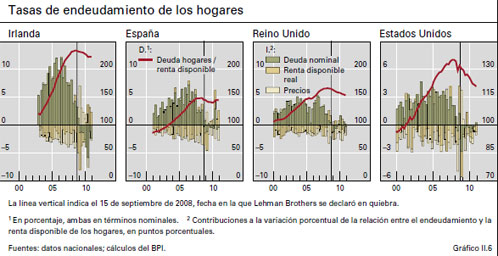
No es, desde luego, el caso de España, donde la tercera parte del endeudamiento público está en manos de bancos y cajas, y si estas sufren en sus balances por la depreciación de sus activos, la única salida es que el Estado ponga más dinero, toda vez que los niveles de deuda privada son también muy elevados.
Eso es lo que temen los mercados. Que nuevos problemas de solvencia obliguen a aumentar los ya de elevadísimos niveles de deuda. Y hay que tener en cuenta que ya este año sólo el Estado –sin contar las administraciones territoriales- ha presupuestado gastar 27.420 millones en el servicio de la deuda. Esto supone que por cada punto que suban los tipos de interés tendrá que desembolsar 274 millones adicionales. Y el diferencial se ha ido ya claramente por encima de los 330 puntos básicos. Lo nunca visto desde que España ingresó en el euro.
Investor fears..about the riots..