The hostages were taken out of their cell one by one.
In a private room, their captors asked each of them three intimate questions, a standard technique used to obtain proof that a prisoner is still alive in a kidnapping negotiation.
James Foley returned to the cell he shared with nearly two dozen other Western hostages and collapsed in tears of joy. The questions his kidnappers had asked were so personal (“Who cried at your brother’s wedding?” “Who was the captain of your high school soccer team?”) that he knew they were finally in touch with his family.
It was December 2013, and more than a year had passed since Mr. Foley vanished on a road in northern Syria. Finally, his worried parents would know he was alive, he told his fellow captives. His government, he believed, would soon negotiate his release.
Continue reading the main storyRELATED COVERAGE
New ISIS Video Features British Hostage, John Cantlie, as SpokesmanSEPT. 18, 2014
For James Foley’s Family, U.S. Policy Offered No HopeSEPT. 15, 2014
In Raid to Save Foley and Other Hostages, U.S. Found NoneAUG. 20, 2014
Before Killing James Foley, ISIS Demanded Ransom From U.S.AUG. 20, 2014
ISIS Video Purports to Show Beheading of James FoleyAUG. 19, 2014
Underwriting Jihad: Paying Ransoms, Europe Bankrolls Qaeda TerrorJULY 29, 2014
What appeared to be a turning point was in fact the start of a downward spiral for Mr. Foley, a 40-year-old journalist, that ended in August when he was forced to his knees somewhere in the bald hills of Syria and beheaded as a camera rolled.
Continue reading the main storyGRAPHIC
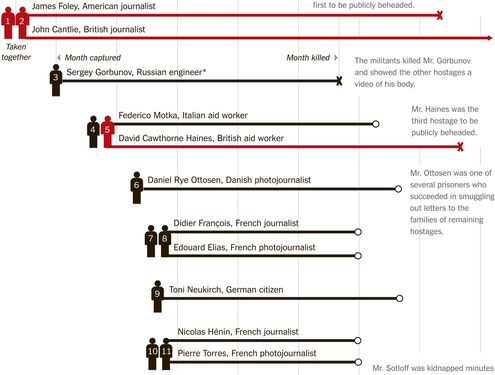
The Fate of 23 Hostages in Syria
At least 23 foreign hostages from 12 countries have been kidnapped by Syrian insurgents, sold or handed over to the Islamic State, and held underground in a prison near the Syrian city of Raqqa.
His videotaped death was a very public end to a hidden ordeal.
The story of what happened in the Islamic State’s underground network of prisons in Syria is one of excruciating suffering. Mr. Foley and his fellow hostages were routinely beaten and subjected to waterboarding. For months, they were starved and threatened with execution by one group of fighters, only to be handed off to another group that brought them sweets and contemplated freeing them. The prisoners banded together, playing games to pass the endless hours, but as conditions grew more desperate, they turned on one another. Some, including Mr. Foley, sought comfort in the faith of their captors, embracing Islam and taking Muslim names.
Their captivity coincided with the rise of the group that came to be known as the Islamic State out of the chaos of the Syrian civil war. It did not exist on the day Mr. Foley was abducted, but it slowly grew to become the most powerful and feared rebel movement in the region. By the second year of Mr. Foley’s imprisonment, the group had amassed close to two dozen hostages and devised a strategy to trade them for cash.
It was at that point that the hostages’ journeys, which had been largely similar up to then, diverged based on actions taken thousands of miles away: in Washington and Paris, in Madrid, Rome and beyond. Mr. Foley was one of at least 23 Western hostages from 12 countries, a majority of them citizens of European nations whose governments have a history of paying ransoms.
Their struggle for survival, which is being told now for the first time, was pieced together through interviews with five former hostages, locals who witnessed their treatment, relatives and colleagues of the captives, and a tight circle of advisers who made trips to the region to try to win their release. Crucial details were confirmed by a former member of the Islamic State, also known as ISIS, who was initially stationed in the prison where Mr. Foley was held, and who provided previously unknown details of his captivity.
The ordeal has remained largely secret because the militants warned the hostages’ families not to go to the news media, threatening to kill their loved ones if they did. The New York Times is naming only those already identified publicly by the Islamic State, which began naming them in August.
Officials in the United States say they did everything in their power to save Mr. Foley and the others, including carrying out a failed rescue operation. They argue that the United States’ policy of not paying ransoms saves Americans’ lives in the long run by making them less attractive targets.
Inside their concrete box, the hostages did not know what their families or governments were doing on their behalf. They slowly pieced it together using the only information they had: their interactions with their guards and with one another. Mostly they suffered, waiting for any sign that they might escape with their lives.
The Grab
It was only a 40-minute drive to the Turkish border, but Mr. Foley decided to make one last stop.
In Binesh, Syria, two years ago, Mr. Foley and his traveling companion, the British photojournalist John Cantlie, pulled into an Internet cafe to file their work. The two were no strangers to the perils of reporting in Syria. Only a few months earlier, Mr. Cantlie had been kidnapped a few dozen miles from Binesh. He had tried to escape, barefoot and handcuffed, running for his life as bullets kicked up the dirt, only to be caught again. He was released a week later after moderate rebels intervened.
They were uploading their images when a man walked in.
“He had a big beard,” said Mustafa Ali, their Syrian translator, who was with them and recounted their final hours together. “He didn’t smile or say anything. And he looked at us with evil eyes.”
The man “went to the computer and sat for one minute only, and then left directly,” Mr. Ali said. “He wasn’t Syrian. He looked like he was from the Gulf.”
Mr. Foley, an American freelance journalist filing for GlobalPost and Agence France-Presse, and Mr. Cantlie, a photographer for British newspapers, continued transmitting their footage, according to Mr. Ali, whose account was confirmed by emails the journalists sent from the cafe to a colleague waiting for them in Turkey.
Photo
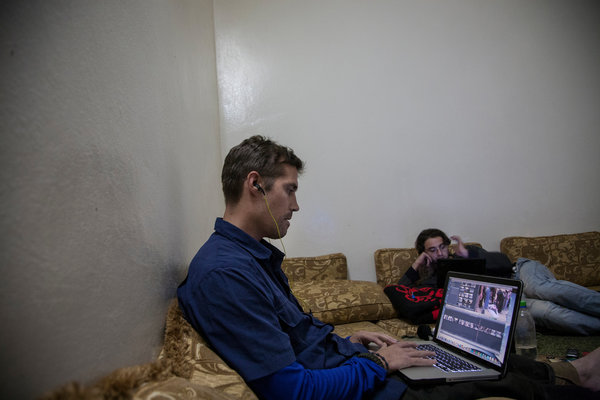
James Foley edited video from Aleppo, Syria, two weeks before he was kidnapped in November 2012.CreditNicole Tung
More than an hour later, they flagged a taxi for the 25-mile drive to Turkey. They never reached the border.
The gunmen who sped up behind their taxi did not call themselves the Islamic State because the group did not yet exist on Nov. 22, 2012, the day the two men were grabbed.
But the danger of Islamic extremism was already palpable in Syria’s rebel-held territories, and some news organizations were starting to pull back. Among the red flags was the growing number of foreign fighters flooding into Syria, dreaming of establishing a “caliphate.” These jihadists, many of them veterans of Al Qaeda’s branch in Iraq, looked and behaved differently from the moderate rebels. They wore their beards long. And they spoke with foreign accents, coming from the Persian Gulf, North Africa, Europe and beyond.
A van sped up on the left side of the taxi and cut it off. Masked fighters jumped out. They screamed in foreign-accented Arabic, telling the journalists to lie on the pavement. They handcuffed them and threw them into the van.
They left Mr. Ali on the side of the road. “If you follow us, we’ll kill you,” they told him.
Over the next 14 months, at least 23 foreigners, most of them freelance journalists and aid workers, would fall into a similar trap. The attackers identified the locals whom journalists hired to help them, like Mr. Ali and Yosef Abobaker, a Syrian translator. It was Mr. Abobaker who drove Steven J. Sotloff, an American freelance journalist, into Syria on Aug. 4, 2013.
“We were driving for only 20 minutes when I saw three cars stopped on the road ahead,” he said. “They must have had a spy on the border that saw my car and told them I was coming.”
The kidnappings, which were carried out by different groups of fighters jousting for influence and territory in Syria, became more frequent. In June 2013, four French journalists were abducted. In September, the militants grabbed three Spanish journalists.
Checkpoints became human nets, and last October, insurgents waited at one for Peter Kassig, 25, an emergency medical technician from Indianapolis who was delivering medical supplies. In December, Alan Henning, a British taxi driver, disappeared at another. Mr. Henning had cashed in his savings to buy a used ambulance, hoping to join an aid caravan to Syria. He was kidnapped 30 minutes after crossing into the country.
The last to vanish were five aid workers from Doctors Without Borders, who were plucked in January from the field hospital in rural Syria where they had been working.
The Interrogation
At gunpoint, Mr. Sotloff and Mr. Abobaker were driven to a textile factory in a village outside Aleppo, Syria, where they were placed in separate cells. Mr. Abobaker, who was freed two weeks later, heard their captors take Mr. Sotloff into an adjoining room. Then he heard the Arabic-speaking interrogator say in English: “Password.”
It was a process to be repeated with several other hostages. The kidnappers seized their laptops, cellphones and cameras and demanded the passwords to their accounts. They scanned their Facebook timelines, their Skype chats, their image archives and their emails, looking for evidence of collusion with Western spy agencies and militaries.
“They took me to a building that was specifically for the interrogation,” said Marcin Suder, a 37-year-old Polish photojournalist kidnapped in July 2013 in Saraqib, Syria, where the jihadists were known to be operating. He was passed among several groups before managing to escape four months later.
“They checked my camera,” Mr. Suder said. “They checked my tablet. Then they undressed me completely. I was naked. They looked to see if there was a GPS chip under my skin or in my clothes. Then they started beating me. They Googled ‘Marcin Suder and C.I.A.,’ ‘Marcin Suder and K.G.B.’ They accused me of being a spy.”
Continue reading the main story
Mr. Suder — who was never told the name of the group holding him, and who never met the other hostages because he escaped before they were transferred to the same location — remarked on the typically English vocabulary his interrogators had used.
During one session, they kept telling him he had been “naughty” — a word that hostages who were held with Mr. Foley also recalled their guards’ using during the most brutal torture.
It was in the course of these interrogations that the jihadists found images of American military personnel on Mr. Foley’s laptop, taken during his assignments in Afghanistan and Iraq.
“In the archive of photographs he had personally taken, there were images glorifying the American crusaders,” they wrote in an article published after Mr. Foley’s death. “Alas for James, this archive was with him at the time of his arrest.”
A British hostage, David Cawthorne Haines, was forced to acknowledge his military background: It was listed on his LinkedIn profile.
The militants also discovered that Mr. Kassig, the aid worker from Indiana, was a former Army Ranger and a veteran of the Iraq war. Both facts are easy to find online, because CNN featured Mr. Kassig’s humanitarian work prominently before his capture.
The punishment for any perceived offense was torture.
“You could see the scars on his ankles,” Jejoen Bontinck, 19, of Belgium, a teenage convert to Islam who spent three weeks in the summer of 2013 in the same cell as Mr. Foley, said of him. “He told me how they had chained his feet to a bar and then hung the bar so that he was upside down from the ceiling. Then they left him there.”
Mr. Bontinck, who was released late last year, spoke about his experiences for the first time for this article in his hometown, Antwerp, where he is one of 46 Belgian youths on trial on charges of belonging to a terrorist organization.
At first, the abuse did not appear to have a larger purpose. Nor did the jihadists seem to have a plan for their growing number of hostages.
Mr. Bontinck said Mr. Foley and Mr. Cantlie had first been held by the Nusra Front, a Qaeda affiliate. Their guards, an English-speaking trio whom they nicknamed “the Beatles,” seemed to take pleasure in brutalizing them.
Later, they were handed over to a group called the Mujahedeen Shura Council, led by French speakers.
Mr. Foley and Mr. Cantlie were moved at least three times before being transferred to a prison underneath the Children’s Hospital of Aleppo.
It was in this building that Mr. Bontinck, then only 18, met Mr. Foley. At first, Mr. Bontinck was a fighter, one of thousands of young Europeansdrawn to the promise of jihad. He later ran afoul of the group when he received a text message from his worried father back in Belgium and his commander accused him of being a spy.
The militants dragged him into a basement room with pale brown walls. Inside were two very thin, bearded foreigners: Mr. Foley and Mr. Cantlie.
Photo
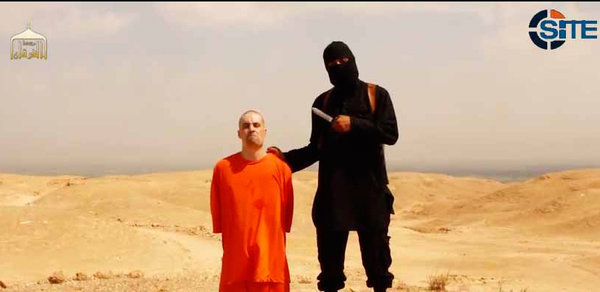
A still image from a video, released in August, in which a militant from the group that calls itself the Islamic State beheaded James Foley.
For the next three weeks, when the call to prayer sounded, all three stood.
An American Named Hamza
Mr. Foley converted to Islam soon after his capture and adopted the name Abu Hamza, Mr. Bontinck said. (His conversion was confirmed by three other recently released hostages, as well as by his former employer.)
“I recited the Quran with him,” Mr. Bontinck said. “Most people would say, ‘Let’s convert so that we can get better treatment.’ But in his case, I think it was sincere.”
Former hostages said that a majority of the Western prisoners had converted during their difficult captivity. Among them was Mr. Kassig, who adopted the name Abdul-Rahman, according to his family, who learned of his conversion in a letter smuggled out of the prison.
Only a handful of the hostages stayed true to their own faiths, including Mr. Sotloff, then 30, a practicing Jew. On Yom Kippur, he told his guards he was not feeling well and refused his food so he could secretly observe the traditional fast, a witness said.
Those recently released said that most of the foreigners had converted under duress, but that Mr. Foley had been captivated by Islam. When the guards brought an English version of the Quran, those who were just pretending to be Muslims paged through it, one former hostage said. Mr. Foley spent hours engrossed in the text.
His first set of guards, from the Nusra Front, viewed his professed Islamic faith with suspicion. But the second group holding him seemed moved by it. For an extended period, the abuse stopped. Unlike the Syrian prisoners, who were chained to radiators, Mr. Foley and Mr. Cantlie were able to move freely inside their cell.
Mr. Bontinck had a chance to ask the prison’s emir, a Dutch citizen, whether the militants had asked for a ransom for the foreigners. He said they had not.
“He explained there was a Plan A and a Plan B,” Mr. Bontinck said. The journalists would be put under house arrest, or they would be conscripted into a jihadist training camp. Both possibilities suggested that the group was planning to release them.
One day, their guards brought them a gift of chocolates.
When Mr. Bontinck was released, he jotted down the phone number of Mr. Foley’s parents and promised to call them. They made plans to meet again.
He left thinking that the journalists, like him, would soon be freed.
A Terrorist State
The Syrian civil war, previously dominated by secular rebels and a handful of rival jihadist groups, was shifting decisively, and the new extremist grouphad taken a dominant position. Sometime last year, the battalion in the Aleppo hospital pledged allegiance to what was then called the Islamic State in Iraq and Syria.
Photo
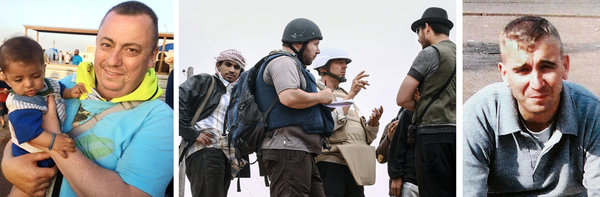
After Mr. Foley, the militants beheaded, from left, Alan Henning, a British taxi driver; Steven J. Sotloff (in the black helmet), an American journalist; and David Cawthorne Haines, a British aid worker.CreditLeft, via Associated Press; center, Etienne de Malglaive, via Getty Images; right, Danny Lawson/PA Wire
Other factions of fighters joined forces with the group, whose tactics were so extreme that even Al Qaeda expelled it from its terror network. Its ambitions went far beyond toppling Bashar al-Assad, Syria’s president.
Late last year, the jihadists began pooling their prisoners, bringing them to the same location underneath the hospital. By January, there were at least 19 men in one 20-square-meter cell (about 215 square feet) and four women in an adjoining one. All but one of them were European or North American. The relative freedom that Mr. Foley and Mr. Cantlie had enjoyed came to an abrupt end. Each prisoner was now handcuffed to another.
More worrying was the fact that their French-speaking guards were replaced by English-speaking ones. Mr. Foley recognized them with dread.
They were the ones who had called him “naughty” during the worst torture. They were the ones the hostages called the Beatles. They instituted a strict security protocol.
When they approached the cell holding Mr. Suder, the Polish photojournalist, they called out “arba’een”: Arabic for the number 40.
That was his cue to face the wall so that when the guards entered, he would not see their faces. Several hostages were given numbers in Arabic, which appeared to be an effort to catalog them — not unlike the numbers American forces had assigned to prisoners in the detention facilities they ran in Iraq, including Camp Bucca, where Abu Bakr al-Baghdadi, the leader of the Islamic State, was briefly held.
“When the Beatles took over, they wanted to bring a certain level of order to the hostages,” said one recently freed European captive.
The jihadists had gone from obscurity to running what they called a state.
In areas under their control, they established an intricate bureaucracy, including a tribunal, a police force and even a consumer protection office, which forced kebab stands to close for selling low-quality products.
That focus on order extended to the hostages.
After months of holding them without making any demands, the jihadists suddenly devised a plan to ransom them. Starting last November, each prisoner was told to hand over the email address of a relative. Mr. Foley gave the address of his younger brother.
The group sent a blitz of messages to the families of the hostages.
Those who were able to lay the emails side by side could see they had been cut and pasted from the same template.
Triage
By December, the militants had exchanged several emails with Mr. Foley’s family, as well as with the families of other hostages.
Photo
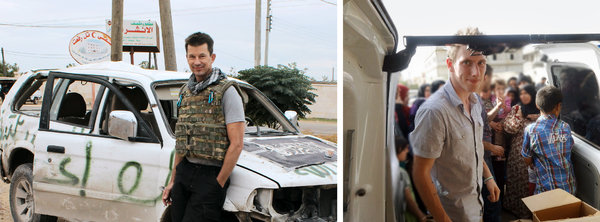
The militants continue to hold three hostages, including John Cantlie, left, a British photojournalist, and Peter Kassig, right, an emergency medical technician from Indiana. They say they will kill Mr. Kassig next.
After the first proof-of-life questions, Mr. Foley was hopeful that he would be home soon. As his second Christmas away from home approached, he threw himself into organizing a jailhouse version of Secret Santa, a tradition in the Foley household.
Each prisoner gave another a gift fashioned out of trash. Mr. Foley’s Secret Santa gave him a circle made from the wax of a discarded candle to cushion his forehead when he bowed down to pray on the hard floor.
As the weeks passed, Mr. Foley noticed that his European cellmates were invited outside again and again to answer questions. He was not. Nor were the other Americans, or the Britons.
Soon, the prisoners realized that their kidnappers had identified which nations were most likely to pay ransoms, said a former hostage, one of five who spoke about their imprisonment in the Islamic State’s network of jails on the condition that their names be withheld.
“The kidnappers knew which countries would be the most amenable to their demands, and they created an order based on the ease with which they thought they could negotiate,” one said. “They started with the Spanish.”
One day, the guards came in and pointed to the three Spanish captives. They said they knew the Spanish government had paid six million euros for a group of aid workers kidnapped by a Qaeda cell in Mauritania, a figure available online in articles about the episode.
As the negotiations for the Spanish prisoners progressed rapidly — the first was released this March, six months after he had been captured — the militants moved on to the four French journalists.
The European prisoners went from answering additional personal questions to filming videos to be sent to their families or governments. The videos became more and more charged, eventually including death threats and execution deadlines in an effort to force their nations to pay.
Continue reading the main story
RECENT COMMENTS
At one point, their jailers arrived with a collection of orange jumpsuits.
In a video, they lined up the French hostages in their brightly colored uniforms, mimicking those worn by prisoners at the United States’ facility in Guantánamo Bay, Cuba.
They also began waterboarding a select few, just as C.I.A. interrogators had treated Muslim prisoners at so-called black sites during the George W. Bush administration, former hostages and witnesses said.
With time, the 23 prisoners were divided into two groups. The three American men and the three British hostages were singled out for the worst abuse, both because of the militants’ grievances against their countries and because their governments would not negotiate, according to several people with intimate knowledge of the events.
“It’s part of the DNA of this group to hate America,” one said. “But they also realized that the United States and Britain were the least likely to pay.”
Within this subset, the person who suffered the cruelest treatment, the former hostages said, was Mr. Foley. In addition to receiving prolonged beatings, he underwent mock executions and was repeatedly waterboarded.
Meant to simulate drowning, the procedure can cause the victim to pass out. When one of the prisoners was hauled out, the others were relieved if he came back bloodied.
Photo
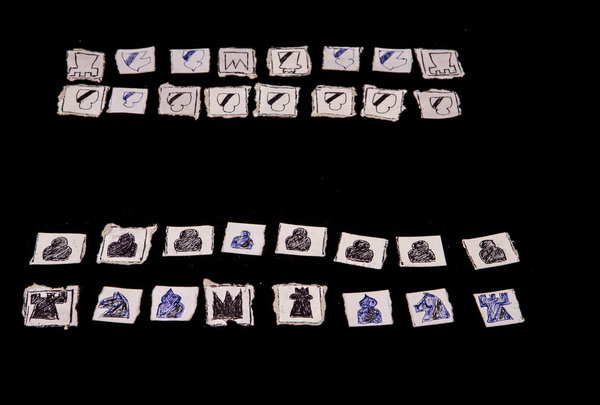
Nearly two dozen Western hostages held together in a 215-square-foot cell in Syria made a chess set from discarded pieces of paper.CreditGlenna Gordon for The New York Times
“It was when there was no blood,” a former cellmate said, “that we knew he had suffered something even worse.”
As the negotiations dragged on, conditions became increasingly grim.
During one extended stretch, the hostages received the equivalent of a teacup of food per day.
They spent weeks in darkness. In one basement, their only illumination was the finger of sunlight that stretched under their locked door. After dusk, they could not see anything, spilling food on themselves until their guards eventually gave them a flashlight.
Most of the locations had no mattresses and few blankets. Some of the prisoners took discarded pants, tied one end and filled the trouser legs with rags to create makeshift pillows.
The prisoners turned on one another. Fights broke out.
Mr. Foley shared his meager rations. In the cold of the Syrian winter, he offered another prisoner his only blanket.
He kept the others entertained, proposing games and activities like Risk, a board game that involves moving imaginary armies across a map: another favorite pastime in the Foley family. The hostages made a chess set out of discarded paper. They re-enacted movies, retelling them scene by scene. And they arranged for members of the group to give lectures on topics they knew well.
Execution Deadlines
This spring, the hostages were moved from below the hospital in Aleppo to Raqqa, the capital of the Islamic State’s self-declared caliphate. They were incarcerated in a building outside an oil installation, where they were again divided by sex.
By March, the militants had concluded the negotiations for the three Spanish journalists.
When the first deliveries of cash arrived, the guards discovered that some of the bills were damaged. They complained to the remaining hostages that their governments did not even have the decency to send crisp notes.
By April, nearly half of the captives had been freed. There had been no progress, however, on the ransom demands the jihadists had made for their American and British hostages.
During the triage phase, the guards identified the single Russian hostage, a man known to the others as Sergey, as the least marketable commodity.
Identified in the Russian news media as Sergey Gorbunov, he was last seen in a video released in October 2013. Stuttering, he said that if Moscow failed to meet the kidnappers’ demands, he would be killed.
Photo
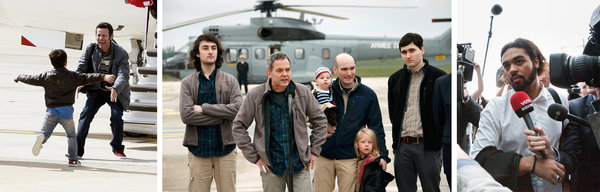
Many European hostages were released after their countries paid ransoms. Among them were Javier Espinosa of Spain, left, reunited with his son; and Edouard Elias, Didier François, Nicolas Hénin and Pierre Torres of France, center. Jejoen Bontinck of Belgium, right, joined the Islamic State but later ran afoul of the group.CreditLeft, Paco Campos/Reuters; center, Gonzalo Fuentes, Reuters; right, Virginia Mayo/Associated Press
Sometime this spring, the masked men came for him.
They dragged the terrified prisoner outside and shot him. They filmed his body. Then they returned to show the footage to the surviving hostages.
“This,” they said, “is what will happen to you if your government doesn’t pay.”
Goodbyes
Mr. Foley watched as his cellmates were released in roughly two-week increments.
As the number of people in the 20-square-meter cell in Raqqa grew smaller, it was hard to stay hopeful. Yet Mr. Foley, who had campaigned for President Obama, continued to believe his government would come to his rescue, said his family, who learned this from recently freed hostages.
On May 27, the few remaining hostages were reminded that different passports spelled different fates.
Those who had been taken together were, in most cases, released together. Not so for the Italian and British aid workers for the Agency for Technical Cooperation and Development, a small French organization, who were grabbed less than a mile from the Turkish border after returning from a refugee camp where they had gone to deliver tents.
In late May, the Italian, Federico Motka, was told he could go, according to a fellow captive, allegedly after Italy paid a ransom. (The Italian government denied the claim.) But his co-worker, Mr. Haines, was left chained inside. Mr. Haines was beheaded in September after being forced to read a script blaming the British government for his death.
By June, the cellblock that had once held at least 23 people had been reduced to just seven. Four of them were Americans, and three were British — all citizens of countries whose governments had refused to pay ransoms.
In an article recently published in an official Islamic State magazine, the jihadists described the American-led airstrikes that began in August as the nail in those hostages’ coffins.
At the same time, they laid out the role European and American ransom policies had played in their decision to kill Mr. Foley.
“As the American government was dragging its feet, reluctant to save James’s life,” they wrote in the magazine, Dabiq, “negotiations were made by the governments of a number of European prisoners, which resulted in the release of a dozen of their prisoners after the demands of the Islamic State were met.”
Fifteen hostages were freed from March to June for ransoms averaging more than two million euros, the former captives and those close to them said.
Among the last to go was a Danish photojournalist, Daniel Rye Ottosen, 25, released in June after his family cobbled together a multimillion-euro ransom, three people briefed on the negotiation said. He was one of several departing hostages who managed to smuggle out letters from his cellmates.
“I am obviously pretty scared to die,” Mr. Kassig wrote in a letter recently published by his family. “The hardest part is not knowing — hoping, and wondering if I should even hope at all.”
Mr. Foley seemed to sense the end was near. In his letter, amid expressions of love, he slipped in a sentence instructing his family on how to disburse the money in his bank account.
In August, when the militants came for him, they made him slip on a pair of plastic sandals. They drove him to a bare hill outside Raqqa. They made him kneel. He looked straight into the camera, his expression defiant. Then they slit his throat.
Two weeks later, a similar video surfaced on YouTube showing Mr. Sotloff’s death. In September, the militants uploaded Mr. Haines’s execution. In October, they killed Mr. Henning. Only three from the original group of 23 remain: two Americans, Mr. Kassig and a woman who has not been identified, as well as a Briton, Mr. Cantlie.
The militants have announced they will kill Mr. Kassig next.
CONTINUE READING THE MAIN STORY 621COMMENTS
Across Europe, those who had survived gasped when they saw the footage of their cellmate’s death: The cheap, beige-colored plastic flip-flops splayed next to Mr. Foley’s body were the same pair the prisoners had shared.
They had all worn those sandals to the bathroom.
Those who survived had walked in the same shoes as those who did not.
Correction: October 25, 2014 An earlier version of a picture caption with this article misspelled the given name of a British aid worker who was beheaded. He is David Cawthorne Haines, not Davis Cawthorne Haines.
Glenna Gordon contributed reporting from Paris, Madrid and Copenhagen; Eric Schmitt from Washington; and Karam Shoumali from Istanbul. Jack Begg, Sheelagh McNeill and Alain Delaquérière contributed research.
A version of this article appears in print on October 26, 2014, on page A1 of the New York edition with the headline: The Horror Before the Beheadings.
NEXT IN MIDDLE EAST
Oil Gives Kurds a Path to Independence, and Conflict With Baghdad
MOST EMAILED
Opinion: The Dangers of Eating Late at Night
What if Age Is Nothing but a Mind-Set?
Well: The Advanced 7-Minute Workout
Gray Matter: The Problem With Positive Thinking
Kissing Your Socks Goodbye
Nicholas Kristof: The American Dream Is Leaving America
Law Lets I.R.S. Seize Accounts on Suspicion, No Crime Required
A Writing Retreat by Rail, From Paris to the Côte d’Azur
Past and Present: Where Americans Turned the Tide in World War I
The Horror Before the Beheadings
View Complete List »
More on nytimes.com
Go to the Middle East Section »
Go to the Home Page »












Eleanor
2 minutes agoIt is pretty well known that the US does not pay ransom. Any private citizen should know they are on their own in the Middle East cauldron....
Ed
2 minutes agoI can't really express the outrage I feel about the death of those hostages. Also I cannot ignore the policies that brought this about. Like...
Eleanore1946
4 minutes agoIf you empower ISIS twits by making them appear omnipotent, you've already lost the battle. These are young, all too naive, all too...